
![[Dome]](../../dome.gif) Interim
Calendar and Briefing
Interim
Calendar and Briefing
November 27, 1996
- Contents:
- Calendar of Scheduled Meetings
- Agenda Information Regarding Scheduled Meetings
- BRIEFINGS - Information Regarding Recent Meetings
 |
|
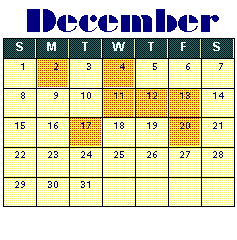
- Monday, December 2, 1996
- INTERPRETIVE SERVICES STUDY COMMITTEE
10:00 a.m., Room 116
- Wednesday, December 4, 1996
- FISCAL COMMITTEE OF THE LEGISLATIVE COUNCIL
10:00 a.m., Room 22
- Wednesday, December 11, 1996
- ADMINISTRATIVE RULES REVIEW COMMITTEE
10:00 a.m., Room 22
- Wednesday, December 12, 1996
- ADMINISTRATIVE RULES REVIEW COMMITTEE
9:00 a.m., Room 22
- Friday, December 13, 1996
- COMPENSATION OF JUSTICES, JUDGES, & MAGISTRATES STUDY COMMITTEE
10:00 a.m., Room 22
- Tuesday, December 17, 1996
- LOCAL INFRASTRUCTURE NEEDS STUDY COMMITTEE - (TENTATIVE)
Time to be Announced, Room 22
- Wednesday, December 18, 1996
- LOCAL INFRASTRUCTURE NEEDS STUDY COMMITTEE
RESCHEDULED ON DECEMBER 17
- Friday, December 20, 1996
- HEDGE TO ARRIVE CONTRACTS STUDY COMMITTEE - (TENTATIVE)
Time and Location to be Announced
|
Temporary Co-chairperson: Senator Elaine Szymoniak
Temporary Co-chairperson: Representative Joseph Kremer
- Location: Committee Room 116, State House, Des Moines
- Date & Time: Monday, December 2, 1996, 10:00 a.m.
- Staff: Richard Nelson, Patty Funaro
- Tentative Agenda:
- Review of current services for adults and schools, programs in other states, and the results of a Deaf Services Commission survey.
- FURTHER INFORMATION: | CHARGE | MEMBERS | STAFF | FINAL REPORT |
Co-chairperson: Senator Larry Murphy
Co-chairperson: Representative David Millage
- Location: Room 22, State House, Des Moines
- Date & Time: Wednesday, December 4, 1996, 10:00 a.m.
- LFB Staff: Tim Faller, Holly Lyons
- LSB Monitor: Kathy Hanlon
- Tentative Agenda: Agenda to be Announced
- FURTHER INFORMATION: | CHARGE | MEMBERS | STAFF | FINAL REPORT |
Co-chairperson: Senator Berl E. Priebe
Co-chairperson: Representative Janet Metcalf
- Location: Committee Room 22, State House, Des Moines
- Date & Time: Wednesday, December 11, 1996, 10:00 a.m., Thursday, December 12, 1996, 9:00 a.m.
- Contact Person: Joe Royce, Legal Counsel, Administrative Rules
- LSB Staff: Kathie Bates, Administrative Code Office
- Tentative Agenda: Agenda (as Published in the Administrative Bulletin)
- FURTHER INFORMATION: | CHARGE | MEMBERS | STAFF | HEARINGS |
Temporary Co-chairperson: Senator Eugene Fraise
Temporary Co-chairperson: Representative Jeff Lamberti
- Location: Committee Room 22, State House, Des Moines
- Date & Time: Friday, December 13, 1996, 10:00 a.m.
- Staff: Leslie Hickey, Mike Kuehn
- Tentative Agenda: Agenda to be Announced
- FURTHER INFORMATION: | CHARGE | MEMBERS | STAFF | FINAL REPORT |
Temporary Co-chairperson: Senator Larry Murphy
Temporary Co-chairperson: Representative Barry Brauns
- Location: Committee Room 22, State House, Des Moines
- Date & Time: Tuesday, December 17, 1996, 10:00 a.m.
- Staff: Susan Crowley
- Tentative Agenda: Agenda to be Announced
- FURTHER INFORMATION: | CHARGE | MEMBERS | STAFF | FINAL REPORT |
Co-chairperson: Senator John Kibbie
Co-chairperson: Representative Russell Teig
- Location: To be Announced
- Date & Time: Friday, December 20, 1996, Time to be Announced
- Staff: Doug Adkisson, Tim McDermott
- Tentative Agenda: Agenda to be Announced
- FURTHER INFORMATION: | CHARGE | MEMBERS | STAFF | FINAL REPORT |
November 18, 1996; First and Final Meeting
- Overview.
- The agenda included presentations by the Department of Natural Resources, the Iowa League of Cities, the Iowa Society of Solid Waste Operators, the Iowa Association of Regional Councils and others with an interest in solid waste reduction and recycling.
- DNR.
- The Department of Natural Resources reviewed the solid waste and recycling programs currently being used, identified the areas which are being targeted for future programs, and reviewed the goal status of the state and individual planning areas.
- Cities.
- The Iowa League of Cities asked that the Legislature consider: (1) eliminating the fines placed on planning areas not reaching the 25 percent reduction level; (2) reducing the tipping fee; (3) requiring greater accountability of the use of the remaining tipping fees; and (4) review the concept of reducing materials entering the waste stream.
- Solid Waste Operators.
- Concerns raised by the Iowa Society of Solid Waste Operators included the effectiveness of the fines imposed for not reaching the 25 percent reduction level, the costs of existing programs, the costs involved in attaining the 50 percent reduction goal, and the need for competitive tonnage fees.
- Regional Councils.
- The Iowa Association of Regional Councils' concerns included the attainability of the 50 percent reduction goal by the year 2000.
- Recommendations.
- Following the presentations and a round-table discussion between the presenters and the members of the Committee, the Committee recommended the following:
- That the Co-chairpersons, with the assistance of the Legislative Service Bureau, draft a report which includes the points of analysis and recommendations made by the presenters and developed by the Committee during the meeting and to which is attached any information provided to the Committee. The report is to be reviewed by all of the members prior to finalization and is to be subsequently submitted to the appropriate standing committees for continued review and further action.
- That all entities which participated in the meeting are to be commended for their hard work and input.
- Staff: Patty Funaro, Tim McDermott
November 19, 1996; First of Two Meetings
- Overview.
- The Hedge to Arrive Contracts Study Committee held its first meeting at Iowa Central Community College in Fort Dodge, Iowa. The meeting was called to order by Co-chairpersons Senator Kibbie and Representative Teig. The Committee was presented testimony from a number of persons as summarized in this briefing.
- Legal Issues.
- Mr. Eric Tabor, Assistant Attorney General, Farm Division, Iowa Attorney General's Office, discussed legal issues involved in the use of Hedge to Arrive (HTA) contracts. Mr. Tabor stated the primary legal issue is whether many HTA contracts under discussion are illegal and unenforceable under the federal Commodity Exchange Act.
- Regulatory Issues.
- Ms. Donna Gwinn, Bureau Chief, Grain Warehouse Bureau, Department of Agriculture and Land Stewardship, discussed regulatory issues involved in HTA contracts. She noted that the department does not regulate HTA contracts, and that the Iowa Grain Depositors and Sellers Indemnity Fund does not cover claims involving credit sale contracts. In related testimony, Mr. Dan Gardiner, an accountant with Gardiner & Company, discussed accounting methods used with HTA contracts.
- Private Producers.
- Ms. Karen Davids, Mr. Paul Harrington, and Ms. Janice Hoover discussed HTA contracts in which they were parties. They expressed concern regarding the provisions of HTA contracts under which they incurred substantial liability. They were critical of elevator operators who offered them contracts. Ms. Davids encouraged the Committee to consider recent legislation enacted in Indiana which regulates the contracts. The Committee also received testimony from Mr. Rueben Skow who stated that elevator managers were trying to be responsive to membership interest when offering HTA contracts, and expressed the belief that there is no legislative solution to the problem.
- Commodities Brokers.
- Mr. Harold Richard, President and CEO of Farmers Commodities Corporation and Mr. C. Richard Stark, President of Iowa Commodities Ltd., represented points of view from two commodities brokerage firms. Mr. Richard stated that the lack of education among producers and elevator managers was a problem, and that the industry is attempting to alleviate problems associated with HTA contracts. He stated that legislation is not necessary and that the problem is limited. Mr. Stark stated that prompt action by the Commodity Futures Trading Commission might have prevented problems associated with the use of HTA contracts. Mr. Stark suggested that the use of multiple year HTA contract should be more closely scruntinized.
- Grain Elevators.
- Several elevator managers presented testimony. Mr. Ron Amundson, General Manager of the Central Iowa Cooperative, stated that there is no legislative solution to the problem and stressed the need for flexibility. Mr. John Peterson, Manager of Farmers Cooperative Company, represented the Iowa Institute of Cooperatives. He stressed the need for education, and expressed concern for a suggestion that a model HTA contract be developed. Mr. David Reiff, President of Reiff Grain and Feed Inc., represented the Agribusiness Association of Iowa. Mr. Reiff discussed competition among elevators and the demand by some producers for HTA contracts. Mr. Reiff expressed confidence in the use of HTA contracts and stated that the Commodity Futures Trading Commission is the proper agency to regulate these instruments.
- Next Meeting.
- The next meeting is scheduled to be held in Des Moines on December 20, 1996.
- Staff: Doug Adkisson, Tim McDermott
November 20, 1996
- Background.
- The Iowa Health Regulation Task Force was established by the Iowa Department of Public Health to review health regulation in Iowa and to make recommendations to the Governor by December 1996 for appropriate changes to improve health care access, cost, and delivery. The Task Force grew out of a health care regulation conference sponsored by state government and private sector organizations held in August 1995. The Task Force membership includes legislators, and representatives of business, labor, health care industry, interest groups, and health care regulators. Three committees are focusing on particular aspects of health regulation.
- Kassebaum-Kennedy Health Insurance Reform Act.
- Mr. Fred Nepple, Counsel to the Wisconsin Insurance Commissioner, provided the full Task Force with an overview of the federal Health Insurance Portability And Accountability Act of 1996. Mr. Nepple summarized the major provisions of the Act establishing federal standards for large group, small group, and individual insurance coverage, and implementation dates. Enforcement of the Act is generally at the state level, unless a state substantially fails to enact the requirements contained in the legislation.
- Health Professions Committee.
- The Committee considered a draft of preliminary recommendations arising out of previous discussions regarding professional scope of practice, organizational structure, and continuing education and competency issues, and invited representatives from various examining boards to contribute their perspectives. In general, the board representatives supported the following preliminary recommendations which will be presented to the Task Force:
- Every board should formulate a plan of evaluation that assesses the manner in which primary regulatory functions are performed. Boards are encouraged to adopt the plans, which should be presented to the director of the Department of Public Health along with any recommendations for improving board operations in conjunction with the 1997 annual report to the Iowa Legislature.
- The Department should refine the "clustering of boards" concept in terms of the criteria for assigning boards to clusters of similarly functioning boards, limiting the number of boards per cluster to no more than four and staffing sufficiently, and instituting regular meetings between boards and agencies and personnel.
- A general principle should be implemented that revenues raised by boards should be appropriated back to them to cover the costs of maintaining an effective regulatory program, and recommended two alternative allocation formulas for adoption by the Legislature.
- Representatives of the boards should be afforded the opportunity to formally address their concerns about proposed revisions to the Iowa Administrative Procedures Acts (Chapter 17A) to the Legislature prior to the Legislature convening, and be provided with regular updates by the Department. This topic is under review by a legislative interim committee, see briefing in this issue.
- Existing continuing education requirements for professionals should remain in place, and boards should be encouraged to adopt administrative rules implementing alternative mechanisms for assessing continuing competency proven to be more effective subsequent to trial and evaluation by another recognized regulatory authority.
- A law should be enacted authorizing the creation of scope of practice review committees to evaluate and make recommendations to the Legislature and boards concerning: (1) requests from practitioners seeking to become newly licensed professions or establish their own regulatory boards; (2) requests from health professionals seeking to expand or narrow the scope of practice of a profession; and (3) unresolved administrative rulemaking disputes between health professions boards. The objective of the scope of practice review committees is to evaluate proposed changes based on objective, technical criteria which assesses whether health professionals have the requisite knowledge, training, experience, and skills to provide the proposed care.
- Next Meeting.
- The final meeting of the Task Force is scheduled for December 11, 1996.
- Staff Contact: Gerd Clabaugh, Department of Public Health
- LSB Monitor: Rick Nelson
November 20, 1996
- The Service Committee agreed to the following report which includes recommendations later approved by the Legislative Council:
- Personnel Reports. Personnel reports were received and filed from the four nonpartisan central staff agencies which the Service Committee oversees. The agencies are the Legislative Service Bureau, Legislative Fiscal Bureau, Legislative Computer Support Bureau, and Office of Citizens' Aide/Ombudsman.
- Staff Issues. The Committee recommended approval of various staff promotions for the central staff agencies.
- Budgets. The Committee recommended approval of the central staff agency budgets for fiscal year 1997-1998.
- Staff: Diane Bolender, Ed Cook
November 20, 1996; Fifth Meeting of the 1995-1996 Biennium
- Overview.
- The Council received recommendations concerning pricing of the Elections Laws Supplement, reports of personnel actions for the central legislative agencies, and budgets for fiscal year 1997-1998 for the central legislative agencies.
- Pricing of Election Laws Supplement.
- The Legislative Council approved the sale price for the 1996 Election Laws Supplement as recommended by the Department of General Services at $22. The Legislative Council also agreed to authorize the legislative leadership to approve the final sale price for the 1997 Code of Iowa.
- Interim Study Committees.
- The Legislative Council directed the authorized interim study committees to continue and complete their study assignments as soon as possible. If individual members wish to withdraw from study committee service, the legislative leadership will name replacements.
- Capitol Parking Lot.
- Question was raised concerning the need for resurfacing of the parking lot adjacent to the east doors to the Capitol, Chairperson Corbett agreed to discuss the matter with representatives of the Department of General Services.
- Expressions of Appreciation.
- Senator Michael Gronstal presented a plaque to Speaker Ron Corbett expressing appreciation of the Council members for Speaker Corbett's two years of service as Chairperson of the Legislative Council. The Legislative Council also expressed its appreciation to the members of the Legislative Council who are retiring from legislative service at the conclusion of the 76th General Assembly.
- Staff: Diane Bolender, Thane Johnson
November 22, 1996; First of Two Meetings
- Background - Preliminary Matters.
- The committee was charged to consider the new Iowa Administrative Procedure Act, reflected in Senate File 2404, and recommendations of state agencies and other interested parties and to attempt to balance the rights of executive branch agencies and citizens in the operation of administrative law. Senator Tom Vilsack and Representative Janet Metcalf were elected co-chairpersons of the committee.
- Proposed New Iowa Administrative Procedure Act (Senate File 2404 introduced in the 1996 Legislative Session) - Overview.
- Roger Stetson, President, Iowa State Bar Association and Professor Arthur Bonfield, University of Iowa described the proposed legislation which would replace current Iowa Code chapter 17A.
- 1. Reasons for the adoption of the new Act:
- The current statute is too sketchy and inadequate to deal with the enormous growth of administrative law described the proposed legislation which would replace current Code chapter 17A.
- The proposal represents a more equitable balance between efficient and economical government and the rights and needs of citizens.
- The current statute makes no effort to proportion adjudication procedures based on the importance of the matters at stake.
- The proposal seeks to ensure effective political control over agency action.
- The current statute does not adequately deal with agency overregulation.
- The proposal enhances public access to agency law and policy.
- The proposal enhances the availability and effectiveness of judicial review of agency action.
- 2. Tom Miller, Attorney General, and Elizabeth Osenbaugh, Solicitor General. Concerns over the adoption of the proposal:
- The Attorney General's office was excluded from the process of developing the Bar Association proposal.
- Although the current law probably provides the state with too many advantages, the Bar Association proposal goes far beyond any real or perceived problems with the current administrative procedure act.
- The new Act is far too complex. Merely increasing the extent of the administrative process does not necessarily lead to greater public fairness or access.
- Increasing the process and the complexity will lead to increased court action concerning agency action.
- Agency flexibility is reduced by the proposal.
- The proposal weakens accountability by providing for waivers of rules and for enhanced gubernatorial veto power over rules.
- Presenters - Rulemaking Issues.
- The following individuals addressed the committee concerning the rulemaking provisions of the proposed new Act. Professor Arthur Bonfield; Elizabeth Osenbaugh; Paul Tanaka, Director, University Legal Services, Iowa State University; Kay Williams, Executive Director, Ethics and Campaign Finance Disclosure Board; Suzan Stewart, Managing Attorney, Mid-American Energy Company; Carl Castelda, Department of Revenue and Finance; Julie Fitzgerald, Iowa Department of Transportation; Mary Ann Walker, Department of Human Services; and Clair Cramer, Iowa Workforce Development.
- Preference for Rulemaking Over Case-By-Case Adjudication.
- Professor Bonfield indicated that the proposal attempts to encourage agencies to adopt law and policy through rulemaking, thereby making it subject to public comment and legislative and gubernatorial oversight, rather than through case by case adjudication. The goal is not increased regulation, but rather increased use of the rulemaking process.
Mr. Tanaka, formerly an attorney in the State of Washington, indicated that the State of Washington recently adopted similar provisions concerning rulemaking and that the resultant increase in agency rulemaking was not beneficial. He noted that a moratorium on rules was requested by the Governor after numerous complaints from business and the legislature later acknowledged that the attempt to increase the use of rulemaking by agencies was not a success.
- Cost/Benefit Analysis.
- Many agency presenters indicated the rulemaking provisions of the proposal will increase their costs through increased recordkeeping requirements and through the need for additional staff time to comply with the additional rulemaking requirements. In addition, the presenters indicated that many of these provisions are not likely to be used by the public and will not increase public access to rulemaking. Professor Bonfield indicated that the proposal does entail some additional cost, as did the enactment of the current administrative procedure act in the 1970's, but that the agencies concerns are likely exaggerated. Ms. Suzan Stewart indicated that the new act would require more work for Mid-American Energy that could better be used in adapting to the rapidly changing nature of the utility industry.
- Concise Explanatory Statement.
- The proposal requires agencies to provide a statement of reasons for any particular rule and also requires agencies to rely only on the reasons provided when attempting to later defend the validity of the rule in subsequent litigation. Professor Bonfield indicated that this requirement enhances the ability of the public to understand rules.
Several presenters indicated that this proposal will require a substantial increase in resources for agencies for little benefit. Currently, persons can request a concise statement but very few do. In addition, given the legal significance of the statement, the reasons are likely to be so detailed or so general so as not to be useful for the general public.
- Waiver of Rules.
- The proposal provides for the waiver of rules under certain situations. Professor Bonfield indicated that this provision is important to try and reduce agency overregulation and to give agencies some flexibility in their rules. Furthermore, he indicated that it is best for the Legislature, and not individual agencies, to set the guidelines for requesting a waiver.
Mary Ann Walker indicated that the Department of Human Services already provides for the ability of persons to request an exception to the rule. Other presenters indicated concern that the public expects an even-handed application of the rules and that this provision could lead to special privileges for a few.
- Public Access to Rulemaking.
- Several agency presenters indicated their concern that under current law, the general public does not become involved in the rulemaking process. However, most of these presenters indicated that the increased procedural hurdles contemplated by the proposal would not solve the problem of public input in the rulemaking process.
- Committee Action - Next Meeting Date.
- The Committee requested that the various parties concerned with the Bar Association proposal try and meet in order to resolve as many of their differences as possible. The Committee indicated that the next meeting date would be delayed until just before the start of the next legislative session.
- Staff: Ed Cook, Doug Adkisson
 Back to top of Interim Information
 Iowa General Assembly
 Search: 1996 Interim (76th General Assembly)
© 1996 Cornell College and
League of Women Voters of Iowa
Comments?
webmaster@legis.iowa.gov.
Last update: Thu Nov 28 19:10:04 CST 1996
URL: /DOCS/GA/76GA/Interim/1996/calendar/961127.htm
sw