
![[Dome]](../../dome.gif) Interim
Calendar and Briefing
Interim
Calendar and Briefing
November 13, 1996
- Contents:
- Calendar of Scheduled Meetings
- Agenda Information Regarding Scheduled Meetings
- BRIEFINGS - Information Regarding Recent Meetings
 |
|
- Monday, November 18, 1996
- SOLID WASTE REDUCTION AND RECYCLING STUDY COMMITTEE
10:00 a.m., Room 22
- Tuesday, November 19, 1996
- HEDGE TO ARRIVE CONTRACTS STUDY COMMITTEE
10:00 a.m., Room 334, Vocational Technical Building, Iowa Central Community College, Fort Dodge, IA
- PROPERTY TAXATION STUDY COMMITTEE - CANCELED
A SUBSTITUTE DATE HAS NOT YET BEEN DETERMINED
- Wednesday, November 20, 1996
- SERVICE COMMITTEE OF THE LEGISLATIVE COUNCIL
10:00 a.m., Room 22
- LOCAL INFRASTRUCTURE NEEDS STUDY COMMITTEE
10:00 a.m., Room116
- LEGISLATIVE COUNCIL
11:00 a.m., Room 22
- Friday, November 22, 1996
- IOWA ADMINISTRATIVE PROCEDURES STUDY COMMITTEE
10:00 a.m., Room 22
- Monday, November 25, 1996
- DHS RESTRUCTURING TASK FORCE
10:00 a.m., Hoover Bldg. Conference Room, B-Level
- Wednesday, November 27, 1996
- LAW ENFORCEMENT TRAINING STUDY COMMITTEE - (TENTATIVE)
10:00 a.m., Room 1 |
 |
|
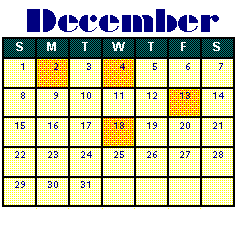
- Monday, December 2, 1996
- INTERPRETIVE SERVICES STUDY COMMITTEE
10:00 a.m., Room 116
- Wednesday, December 4, 1996
- FISCAL COMMITTEE OF THE LEGISLATIVE COUNCIL - (TENTATIVE)
Time and Location to be Announced
- Friday, December 13, 1996
- Compensation of Justices, Judges, & Magistrates Study Committee - TENTATIVE
10:00 a.m., Room 22
- Wednesday, December 18, 1996
- LOCAL INFRASTRUCTURE NEEDS STUDY COMMITTEE -
(TENTATIVE)
Time to be Announced, Room 22
|
Temporary Co-chairperson: Senator Patrick J. Deluhery
Temporary Co-chairperson: Representative Clyde Bradley
- Location: Committee Room 22, State House, Des Moines
- Date & Time: Monday, November 18, 1996, 10:00 a.m.
- Staff: Patty Funaro
- Tentative Agenda:
- Overview of waste management practices throughout the state and progress toward meeting statutory goals for solid waste reduction and recycling.
- FURTHER INFORMATION: | CHARGE | MEMBERS | STAFF | FINAL REPORT |
Temporary Co-chairperson: Senator John P. Kibbie
Temporary Co-chairperson: Representative Russell Teig
- Location: Room 334, Vocational Technical Building, Iowa Central Community College, 330 Avenue M, Fort Dodge, IA
- Date & Time: Tuesday, November 19, 1996, 10:00 a.m.
- Staff: Doug Adkisson
- Tentative Agenda:
- Presentations from a number of persons involved in the issue.
- FURTHER INFORMATION: | CHARGE | MEMBERS | STAFF | FINAL REPORT |
Chairperson: Senator Michael Gronstal
- Location: Committee Room 22, State House, Des Moines
- Date & Time: Wednesday, November 20, 1996, 10:00 a.m.
- Staff: Diane Bolender, Ed Cook
- Tentative Agenda: Agenda to be Announced
- FURTHER INFORMATION: | CHARGE | MEMBERS | STAFF | FINAL REPORT |
Temporary Co-chairperson: Senator Larry Murphy
Temporary Co-chairperson: Representative Barry Brauns
- Location: Room 116
- Date & Time: Wednesday, November 20, 1996, 10:00 a.m.
- Staff: Susan Crowley
- Tentative Agenda:
- Presenattions from local government representatives and others on local infrastructure financing and on proposals to meet local infrastructure needs.
- FURTHER INFORMATION: | CHARGE | MEMBERS | STAFF | FINAL REPORT |
Chairperson: Speaker Ron Corbett
Vice Chairperson: Senator Wally Horn
- Location: Committee Room 22, State House, Des Moines
- Date & Time: Wednesday, November 20, 1996, 11:00 a.m.
- Staff: Diane Bolender, Thane Johnson
- Agenda: Agenda to be Announced
- FURTHER INFORMATION: | CHARGE | MEMBERS | STAFF | FINAL REPORT |
Temporary Co-chairperson: Senator Tom Vilsack
Temporary Co-chairperson: Representative Janet Metcalf
- Location: Committee Room 22, State House, Des Moines
- Date & Time: Friday, November 22, 1996, 10:00 a.m.
- Staff: Ed Cook, Doug Adkisson
- Tentative Agenda:
- Presentations from the Iowa State Bar Association, state agencies, and others concerning proposals to revise Iowa's Administrative Procedures Act.
- FURTHER INFORMATION: | CHARGE | MEMBERS | STAFF | FINAL REPORT |
Co-chairperson: Senator Johnie Hammond
Co-chairperson: Representative Hubert Houser
- Location: Hoover State Office Building Conference Room, B-Level, Des Moines
- Date & Time: Monday, November 25, 1996, 10:00 a.m.
- Staff: Patty Funaro, Rick Nelson
- Tentative Agenda: Agenda to be Announced
- FURTHER INFORMATION: | CHARGE | MEMBERS | STAFF | FINAL REPORT |
Temporary Co-chairperson: Senator Randal Giannetto
Temporary Co-chairperson: Representative Teresa Garman
- Location: Committee Room 1, State House, Des Moines
- Date & Time: Wednesday, November 27, 1996, Time to be Announced
- Staff: Kathy Hanlon, Jan Simmons
- Tentative Agenda: Agenda to be Announced
- FURTHER INFORMATION: | CHARGE | MEMBERS | STAFF | FINAL REPORT |
Temporary Co-chairperson: Senator Elaine Szymoniak
Temporary Co-chairperson: Representative Joseph Kremer
- Location: Committee Room 116, State House, Des Moines
- Date & Time: Monday, December 2, 1996, 10:00 a.m.
- Staff: Richard Nelson, Patty Funaro
- Tentative Agenda:
- Review of current services for adults and schools, programs in other states, and the results of a Deaf Services Commission survey.
- FURTHER INFORMATION: | CHARGE | MEMBERS | STAFF | FINAL REPORT |
Co-chairperson: Senator Larry Murphy
Co-chairperson: Representative David Millage
- Location: To be Announced
- Date & Time: Wednesday, December 4, 1996, Time to be Announced
- LFB Staff: Tim Faller, Holly Lyons
- LSB Monitor: Kathy Hanlon
- Tentative Agenda: Agenda to be Announced
- FURTHER INFORMATION: | CHARGE | MEMBERS | STAFF | FINAL REPORT |
Temporary Co-chairperson: Senator Eugene Fraise
Temporary Co-chairperson: Representative Jeff Lamberti
- Location: Committee Room 22, State House, Des Moines
- Date & Time: Friday, December 13, 1996, 10:00 a.m.
- Staff: Leslie Hickey, Mike Kuehn
- Tentative Agenda: Agenda to be Announced
- FURTHER INFORMATION: | CHARGE | MEMBERS | STAFF | FINAL REPORT |
Temporary Co-chairperson: Senator Larry Murphy
Temporary Co-chairperson: Representative Barry Brauns
- Location: Committee Room 22, State House, Des Moines
- Date & Time: Wednesday, December 18, 1996, Time to be Announced
- Staff: Susan Crowley
- Tentative Agenda: Agenda to be Announced
- FURTHER INFORMATION: | CHARGE | MEMBERS | STAFF | FINAL REPORT |
November 7, 1996
- Background.
- In the wake of federal Welfare Reform measures and based upon directives provided by the 1996 General Assembly, the Department of Human Services established the Iowa Welfare Reform Advisory Group to review federal welfare reform and its impact on Iowa and to develop recommendations for policy makers regarding program and implementation options.
The Advisory Group membership includes legislators from the human resources standing committees and human services joint appropriations subcommittee, state agency staff, church and private agency representatives, and Family Investment Program participants. Five work groups were created to provide an in-depth review of various policy areas and to make recommendations to the full advisory group.
- Federal Block Grant.
- The federal legislation names the block grant which replaces Aid to Families with Dependent Children (AFDC) as "Temporary Assistance to Needy Families" (TANF). As part of Iowa's welfare reform enactments in 1993, the Iowa program was renamed the Family Investment Program (FIP). The federal legislation authorizes Iowa to select a date to commence implementation of the block grant. The Iowa General Assembly enacted 1996 Iowa Acts, chapter 1210, H.F. 2486, allowing for implementation of the block grant prior to the convening of the 1997 Session of the General Assembly if certain contingency provisions were met.
- Implementation Recommendation.
- The Advisory Group received a report from the Block Grant Implementation Process Work Group. The Work Group submitted a recommendation regarding when the state should implement the TANF program.
The federal legislation requires that a state plan describing the state's implementation proposal be submitted to the Secretary of Health and Human Services no later than July 1, 1997. Additionally, a 45-day public comment period, which may be held prior to or concurrent with submission of the plan, is required. A state may choose to submit a plan prior to the July 1, 1997, date and may withdraw or modify a plan which is submitted early, without penalty, prior to the end of the 45-day comment period.
At the time of implementation, Family Investment Program (FIP) recipients become subject to a five-year lifetime limitation for receipt of FIP benefits and are subject to a requirement that a FIP recipient be engaged in work within two years of receipt of benefits.
States which submit a plan and choose to implement TANF prior to the mandatory submission date of July 1, 1997, would receive a prorated portion of their block grant for the months prior to the mandatory implementation date.
Following discussion of the options for implementation, a motion was made to submit the state plan on November 15, 1996, at which time the public comment period would begin, with the caveat that public comment and education would continue beyond the 45-day period. This would result in implementation of the TANF program following the 45th day after submission of the plan, or December 31, 1996, at the earliest. The Advisory Group approved the motion unanimously.
- Control Groups.
- The Advisory Group also recommended that Iowa eliminate control groups which were implemented under Iowa's welfare reform as part of federal requirements. Members expressed the belief that the welfare reform provisions are more advantageous to recipients than are control group provisions.
- Community Service Option.
- The Advisory Group also approved a motion to recommend the Governor opt out of a provision in the federal legislation which otherwise would require recipients not engaged in work within two months of receiving FIP to participate in community service. The Advisory Group agreed that Iowa's Family Investment Agreements currently provide for participation in community service and that an additional program is not necessary to involve recipients in community service.
- Next Meeting.
- The next meeting of the Advisory Group will be held on December 9, 1996, with the location to be announced. Workgroups continue to meet on a regular basis.
- Staff: Doug Howard, Department of Human Services
- LSB Monitor: Patty Funaro
November 7, 1996
- Background.
- The Task Force was established to prepare a report and make recommendations to the interim committee on Local Corrections Infrastructure and Crime Prevention Review. The report of the Task Force is scheduled to be presented to the interim committee on December 3. The interim committee will be meeting in December to review the report, on dates which have yet to be determined.
- Presentations before the Task Force.
- Task Force members heard a presentation on regional jails, presented by Gorden Plepla, a criminal justice consultant, and Barney Bishop, a Vice President of Durrant Architects, and a presentation on chronic juvenile offenders, presented by James "Buddy" Howell, Former Director of Research and Program Development Office of Juvenile Justice and Delinquency Prevention, of the United States Department of Justice.
- Discussions by the Task Force.
- Task Force members reviewed samples of the templates and responses for the facility inventory, which has been sent to all local correctional facilities in the state. Task Force members were also updated on the progress of the program inventory. Task Force members then approved the outline and format for the final report, and reviewed the written summaries of the comments made in the focus group meetings and public hearings held at 11 locations throughout the state during the month of October. From those comments, Task Force staffers made findings, and identified 6 critical issues around which the report of the Task Force will be structured. Task Force members discussed these critical issues, and made preliminary recommendations addressing those issues.
- Future Task Force Meetings.
- The Task Force is tentatively scheduled to meet on November 22 and December 3, 1996. If held, one or both of these meetings may be held via the ICN. If you are interested in attending these meetings, please check with Task Force staffers closer to the meeting dates for precise meeting times and locations.
- LSB Monitor: Jan Simmons
- Task Force Staff: Tom Slater and Arlinda McKeen
November 7, 1996 - Final Report
Final Report. On November 7, l996, the Governor's Committee on Government Spending Reform presented its Final Report to Governor Terry E. Branstad. The Final Report includes the recommendations of two subcommittees created by the Governor's Committee. The subcommittees are the Budgeting Practices Subcommittee and the Infrastructure Subcommittee.
- Budget Practices Subcommittee
- Mission. The Budget Practices Subcommittee was charged with the following mission by the Governor's Committee:
- To review, analyze, and make recommendations about budgeting practices, including biennial budgeting, that will promote a multi-year perspective in decision making.
- To review, analyze, and make recommendations about technology funding, including funding sources, prioritization and decision making process.
- Recommendations. The final recommendations on budgeting practices include:
- Preparation of a four-year financial projection beyond the current year, shared by the Governor with the General Assembly for informational purposes, complete with assumptions used for the projections, and developed collaboratively, to the extent possible, with the Legislative Fiscal Bureau.
- Attachment of a five-year economic and revenue projection prepared by the Iowa Institute of Economic Research or other independent organization, to the budget materials shared by the Governor with the General Assembly.
- Requirement that fiscal notes incorporate multi-year fiscal impact information.
- A study of the feasibility of extending the collective bargaining cycle beyond two years.
- Publication, in list form and in individual appropriation bills, of a list of spending commitments that automatically create an increase in spending beyond the year budgeted.
- Weekly preparation, toward the end of a legislative session, of a statement of estimated financial condition for the year after the year being budgeted, incorporating the list of automatic spending increases.
- Adoption of modified biennial budgeting on a statewide basis by the year 2002; biennial budgeting for all capital needs; and establishment of an overall spending target for the second year of the biennium.
- Information Technology Funding. The Budgeting Practices Subcommittee also made recommendations on information technology ( IT) funding as follows:
- Development of a "checklist" for department IT requests to ensure requests meet enterprise-wide standards and inter-connectivity criteria and development of a prioritization process for multi-agency IT requests, coordinated through the new IT agency.
- Establishment of an IT Review Team to evaluate multi-agency IT requests.
- Legislative creation of a joint appropriation subcommittee to review IT agency budget requests and multi-agency IT requests.
- Establishment of a dedicated funding source for large-scale, multi-agency IT projects.
- Creation of educational opportunities for all branches of government to enhance understanding of the significant role of IT in government.
- Infrastructure Subcommittee
- Mission. The Infrastructure Subcommittee was charged with the following mission by the Governor's Committee:
- To define infrastructure and identify the 'scope' of State assets.
- To make specific recommendations on a methodology for identification and prioritization of infrastructure projects.
- To make specific recommendations on a methodology for allocation of resources relative to infrastructure projects.
- Recommendations. The final recommendations of the Infrastructure Subcommittee include the following:
- Definition of key terms.
- Amend current law relating to the infrastructure funding from the Rebuild Iowa Infrastructure Fund (RIIF).
- Establish a citizen Rebuild Iowa Infrastructure Board of seven members for staggered terms of six years, appointed by the Governor and confirmed by the Senate.
- Provide staff support to the Board by statute.
- Establish a mandatory, comprehensive, initial audit and centrally maintained on-going inventory of state vertical infrastructure assets.
- Allocate funding by the Board to vertical infrastructure projects. The Governor and the General Assembly should be allowed to veto projects on the approved project list prepared by the Board, but not add projects not recommended by the Board.
- Establish a priority system for RIIF funding of vertical infrastructure projects based on objective criteria.
- Provide funding in the following order: emergency repairs and replacement, deferred maintenance, renovation, and other projects based upon objective criteria.
- Inclusion of life safety, accessibility, historic preservation, and energy conservation as important criteria.
- Require that projected operations costs, including maintenance and repair and replacement are calculated for a new infrastructure project and are funded by a committed source of revenue.
- Establish a mandatory capital asset management program, including the use of a three-tiered system of annual facility audits.
- Require that the General Assembly fund annual departmental operating budgets for routine and preventive maintenance at the minimum annual level of 1.5 percent of current replacement value.
- Require that the General Assembly create a reserve fund for repair and replacement of finishes, systems, equipment, and property, over the design life of the facility. The minimum annual funding level should be 3.5 percent of the building's current replacement values.
- Require that the Board publish an annual square foot replacement value for vertical infrastructure which is drawn from available national data.
- Require the Board to develop and maintain a comprehensive five-year strategic facilities plan for maintenance , repair and replacement, and renovation of vertical infrastructure in cooperation with all state agencies, updated annually.
- Other Issues.
- During its deliberations, the Governor's Committee identified additional issues which should be addressed but were not deemed to be within the scope of the current missions. These topics are as follows:
- Feasibility of state funding of local infrastructure needs.
- Additional changes to right-size or downsize state government.
- Additional sharing of public personnel or services between levels of government.
- Review of salaries and benefits including the investigation of the disparity between public and private sectors.
- Consolidation of the Office of Secretary of State.
- Extend renewal period of motor vehicle licenses from two to five years.
- Extend the renewal period of other licenses.
- Staff: Patti Schroeder, Department of Management
- LSB Monitor: Thane Johnson
November 11, 1996
- Background.
- The Task Force was organized by the Governor in spring 1996 and selected Arthur Andersen LLP, Chicago and McGladrey and Pullen LLP, Des Moines as a consultant team in May 1996. The mission of the Task Force includes an examination of Iowa's tax structure to assess its impact on Iowa's economic growth and ability to attract and maintain quality jobs. To accomplish this mission, meetings and workshops were held as well as interviews with executives of various companies and focus groups.
- Previously Discussed Findings.
- The consultants recapped the state tax comparison of Iowa with eight other states and the phone survey findings on economic development and tax policy which had previously been discussed with the Task Force.
The tax comparisons with Illinois, Indiana, Ohio, Wisconsin, Minnesota, Missouri, Nebraska, and South Dakota indicated:
- Personal Income Tax: Iowa has the highest top rate; Missouri and Iowa are the only states with federal income tax deduction; Iowa's standard deductions are much lower and have not kept pace with increases in federal standard deductions.
- Business-Corporate Income/Franchise Tax: Iowa's top rate is the highest; Iowa and Missouri have 50 percent federal corporate income tax deduction; and Iowa and Nebraska are only states to have a single factor apportionment formula which is considered by business to be a competitive advantage.
- Property Tax: Iowa's tax on personal property is favorable compared to others in that there are exemptions for inventory, manufacturing machinery and equipment, air and water pollution devices, and software; Iowa exempts most personal property with exception of property owned by utilities.
- Unemployment Tax: Iowa's new employer rate of 1.05 percent is lowest; tax wage base is the second highest; the effective rate is the lowest.
- Sales/Use Tax: Iowa's 5 percent rate is in the middle; Iowa's local sales tax is second to Wisconsin; and only Illinois and Indiana have sales tax on gasoline.
Findings of the Economic Development and Tax Policy Survey indicated:
- Both Iowa and other states' firms ranked the tax climate as more important than government incentives.
- While Iowa rates higher than other states overall, more than half of the companies interviewed do not find Iowa's business tax climate to be favorable for their business.
- The phone survey of Iowa firms showed that 53 percent consider the personal income tax as unfavorable for business - no other tax received such a high unfavorable rating.
- The property tax had the highest favorable rating with 49 percent considering it favorable for business. Iowa's recent law changes to exempt machinery and equipment appear to have contributed to this favorable view. Negative comments were made about high residential property taxes hurting employee recruitment.
- The unemployment/worker's compensation tax received a high favorable (38 percent) and low unfavorable rating (19 percent) indicating that Iowa's rates are competitive with other states.
- The business income and franchise tax received an overall favorable ranking (39 percent favorable compared to 25 percent unfavorable) with positive comments about the single factor base and negative comments about high rates hurting out of state recruitment.
- The sales tax received a high favorable rating (38 percent) and the lowest unfavorable rating (16 percent) of all the tax categories with most firms indicating that sales taxes have the least impact on their competitiveness.
- Review of Interview Results.
- To further refine the findings of the business firm phone survey and to obtain more in-depth suggestions, a series of in-person interviews were held with business and community leaders. The focus of the interviews was the impact of state tax policy on their business or their economic development efforts.
A variety of firms types were selected with a special emphasis on the targeted business types. A range of cities both in terms of size and various locations in the state were also selected. Input was also obtained from academics.
Although there are differences of opinion in some areas, there are several common findings that emerged in the interviews, as follows:
- Iowa's top personal income and corporate income tax rates are a negative factor in recruiting out-of-state firms.
- The repeal of the federal income tax deduction could be connected with measures to limit future tax rate increases.
- Residential property tax rates are also a negative for employee recruitment and retention - this is aggravated by an acute shortage of affordable housing.
- The machinery and equipment property tax exemption is a positive and further shifts away from property taxes are not needed at this time for manufacturing.
- Sales taxes could be expanded, by increasing the items and services covered, and/or by increasing the rate by 1 percent.
- The inheritance tax should be eliminated to retain more retirees in Iowa, although this will have little impact on business competitiveness.
- Tax Increment Districts (TIFs), especially when utilized for job training, and the Job Training Credits are considered key competitive tools for Iowa.
- There is an emerging shortage of labor in key areas which may increase the need for tax changes to recruit more employees and which would also suggest the need for a separate examination of tax and other measures which could help relieve the shortage of affordable housing which is also impacting labor availability.
- Review of Findings of Survey Conducted of Focus Groups.
- To further refine the findings of the firm phone survey and the in-person interviews, two focus groups were conducted with business executives and decision-makers. These participants were picked to reflect the targeted industries and nearly all had earlier participated in either a phone survey or personal interview.
The discussion was generated by asking questions about those tax features most important to the participant companies and those changes seen as most effective in increasing business competitiveness.
The results of the focus groups are summarized below:
- Key Focus Group Findings.
- Key findings of the focus groups include the following:
- Personal income tax rates should be lowered because they are making it difficult to recruit both companies and employees.
- The sales taxes and a sales tax on gasoline were the taxes for which the participants were willing to accept a tax rate increase.
- The shortage of affordable housing as major factor impacting the ability to attract employees was raised by the first group - the second group concurred that it is a major problem.
- A full deduction for child care costs for all income groups was supported - like the housing shortage, it was felt this impacts labor availability.
- Firms were unwilling to sacrifice tax credits, tax increment districts, and other economic incentives for lower taxes.
- Policy Options.
- The options were divided into short term and long term with preference given to personal income tax changes. It was emphasized that a difference exists in policies responding to facts and those responding to perceptions. The following are strategies options that were favored:
- Personal income tax: Short-term - make competitive by lowering effective top rate to 4 - 5.5 percent. Long term - eliminate federal income tax deduction if combined with a constitutional amendment to require a 60 percent majority vote to increase taxes.
- Inheritance tax: Eliminate.
- Corporate tax: Short term - effective top rate set at 7.5 - 9 percent.
- Property tax: Short term - continue reduction in taxes on residential property. Long term - reduce taxes on industrial property. Both short term and long term continue property tax credits as a method for reducing taxes.
- Other items needed in order to be competitive involve the availability of affordable housing and day care services. These may be provided by use of some sort of tax credits, deductions, or other incentives.
- LSB Monitor: Mike Goedert
- Staff Contact: Steve Maslikowski, Department of Management
 Back to top of Interim Information
 Iowa General Assembly
 Search: 1996 Interim (76th General Assembly)
© 1996 Cornell College and
League of Women Voters of Iowa
Comments?
webmaster@legis.iowa.gov.
Last update: Mon Nov 25 09:50:03 CST 1996
URL: /DOCS/GA/76GA/Interim/1996/calendar/961113.htm
sw