
![[Dome]](../../dome.gif) Interim Calendar and Briefing
Interim Calendar and Briefing
September 11, 1996
- Contents:
- Calendar of Scheduled Meetings
- Agenda Information Regarding Scheduled Meetings
- BRIEFINGS - Information Regarding Recent Meetings
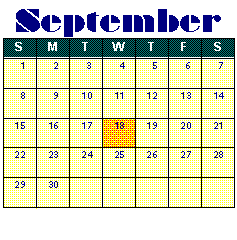 | |
- Fiscal Committee of the Legislative Council
9:00 a.m., Iowa State University, College of Veterinary Medicine, Alumni Room, Ames, Iowa
|
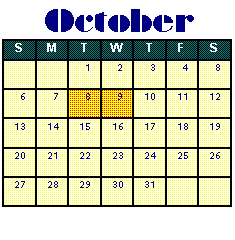 | |
- Tuesday, October 8, 1996
- Administrative Rules Review Committee - TENTATIVE
10:00 a.m., Room 22
- Wednesday, October 9, 1996
- Administrative Rules Review Committee - TENTATIVE
9:00 a.m., Room 22
|
Co-chairperson: Senator Larry Murphy
Co-chairperson: Representative David Millage
- Location: College of Veterinary Medicine, Alumni Room,
Iowa State University, Ames, Iowa
- Date & Time: September 18, 1996, 9:00
- LSB Monitor: Doug Adkisson
- LFB Staff: Tim Faller, Holly Lyons
- Tentative Agenda:
- Lottery administrative expenses
- Healthy livestock
- Student financial aid
- Tour of ISU programs and facilities
- FURTHER INFORMATION| CHARGE | MEMBERS | STAFF | HEARINGS |
Co-chairperson: Senator Berl E. Priebe
Co-chairperson: Representative Janet Metcalf
- Location: Committee Room 22, State House, Des Moines
- Date & Time: Tuesday, October 8, 1996, 10:00 a.m., Wednesday, October 9, 1996, 9:00 a.m.
- Tentative Agenda: Agenda (as Published in the Administrative Bulletin)
- Contact Person: Joe Royce, Legal Counsel, Administrative Rules
- LSB Staff: Kathie Bates, Administrative Code Office
- FURTHER INFORMATION| CHARGE | MEMBERS | STAFF | HEARINGS |
September 6-7, 1996
- Background.
- Senate File 13, as enacted by the 1996 General Assembly, directed that a Prospective Minor Parents Program Advisory Committee be created to carry out duties prescribed in the Act including the development and distribution of a video to be viewed by prospective minor parents, receiving of public input relative to the program, and ongoing evaluation of the program.
- Vendor Selection.
- The Committee met to select a vendor for the production and distribution of a decision-making video as required pursuant to S.F. 13. Following presentations by 9 applicants on Friday evening, the Committee selected American Media Incorporated of West Des Moines, Iowa. The Committee continued the discussion regarding clarification of the vision for the video.
- Next Meeting.
- The next meeting of the Committee will be held on Thursday, September 19, 1996, at which time the Committee will discuss the outline for video production.
- LSB Monitor: Patty Funaro
- Overview.
- The U.S. Supreme Court issued two decisions this term which bolstered the right of government to seize property involved in or related to criminal activity by rejecting two different types of defenses frequently asserted in recent forfeiture actions. In rejecting the "innocent owner" defense, the court upheld the right of the government to seize such property whenever the owner of the property consents to its use by the perpetrator of a criminal act, even if the property owner has no knowledge of the criminal activity in which the perpetrator involves the property. And, in another case, the court rejected the "double jeopardy" defense, stating that the use of civil forfeiture proceedings in conjunction with a criminal prosecution related to the same underlying criminal act does not consitute more than one punishment for the same offense. In both decisions, the court reaffirmed long-standing forfeiture case law, and expressly declined to expand the principles of certain civil forfeiture decisions issued by the Court in late 1980s and early 1990s which limited the use of civil forfeiture under some circumstances.
- "Innocent Owner Defense".
- Bennis v. Michigan (decided March 4, 1996). The state statute at issue permitted the state to seize property involved in criminal activity without proof of knowledge by the owner that the property was engaged in such activity. A co-owner of a vehicle seized under this statute claimed that the statute violated her due process rights because it did not require the prosecutors to establish any criminal intent on her part in order to justify the seizure of the property. However, the Court found that seizure of property involved in criminal activity, without consideration of the knowledge of the owner with regard to the use of the property in the criminal activity, is well-fixed in the law. The court expressly refused to overrule this legal principle, noting also that the statute at issue was an equitable one, which allowed the judge to consider all facts related to the property and to consider alternatives to a complete forfeiture of an interest in the property.
One of the dissenting opinions, however, questioned whether the vehicle in question was sufficiently tainted by the criminal activity in question to justify its forfeiture under the statute, because it could be viewed simply as the location where the crime occurred, and the court has previously declined to support seizure of such "locations." The concurrence similarly queried the appropriate limits of what constitutes seizable "property" under civil forfeiture statutes according to the "use" of the property in the criminal act.
- "Double Jeopardy Defense".
- U.S. v. Ursery (decided June 24, 1996). Government prosecutors simultaneously used civil forfeiture proceedings against defendants' property, and criminal prosecutions against defendants, based on charges that defendants engaged in illegal drug activity. Defendants challenged the dual proceedings as a violation of the double jeopardy clause, which prohibits multiple punishments for the same crime. In an 8-1 decision, the Court held that in rem civil forfeiture actions (legal proceedings against property) do not violate the double jeopardy clause, because they are neither punishment nor a criminal proceeding.
The opinion of the court noted that in an in rem proceeding, the property owner must defend the property's role in the criminal offense. Forfeiture of property which is used to commit a crime or which was purchased with the proceeds of a crime does not serve as punishment, because it serves broader remedial aims, such as removing dangerous property from society and deterring certain types of conduct, rather than merely compensating the government for the costs incurred by the government as a result of the illegal acts, which is the aim of a civil penalty, according to the court.
The dissent expressed a belief that there is little practical difference between a civil penalty and a civil forfeiture, and that the latter could be punitive, as well. Consequently, the dissent would not have declared civil forfeiture proceedings outside of the limitations of the double jeopardy clause.
- Congressional Action.
- Reform to some federal civil forfeiture statutes is being considered in Congress. HR 1916 proposes changes that would require the government to prove by clear and convincing evidence that the seized property is subject to forfeiture, would protect innocent property owners if they could show either a lack of consent to use the seized property or a lack of knowledge of the involvement of the property in the crime, and would increase to 30 days the time period for challenging a property seizure by the federal government. Initial hearings were held on HR 1916 in late July, with further action expected to occur sometime in September.
- Contact Person: Jan Simmons
 Back to top of Interim Information
 Iowa General Assembly
 Search: 1995 Interim (76th General Assembly)
© 1996 Cornell College and
League of Women Voters of Iowa
Comments?
webmaster@legis.iowa.gov.
Last update: Mon Sep 23 11:20:03 CDT 1996
URL: /DOCS/GA/76GA/Interim/1996/calendar/960911.htm
sw