
![[Dome]](../../dome.gif) Interim Calendar and Briefing
Interim Calendar and Briefing
June 16, 1997
- Contents:
- Calendar of Scheduled Meetings
- Agenda Information Regarding Scheduled Meetings
- BRIEFINGS - Information Regarding Recent Meetings
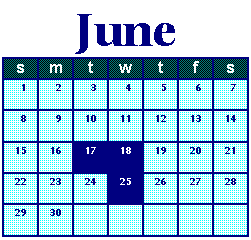 |
- Tuesday, June 17, 1997
- Cost Subcommittee of the County Issuance of Motor Vehicle Licenses Study Committee
9:00 a.m., Room 1
- Technology Subcommittee of the County Issuance of Motor Vehicle Licenses Study Committee
1:00 p.m., Room 1
- Wednesday, June 18, 1997
- Quality Subcommittee of the County Issuance of Motor Vehicle Licenses Study Committee
10:00 a.m., Room 1
- Wednesday, June 25,1997
- Studies Committee of the Legislative Council
10:30 a.m., Room 24
- Service Committee of the Legislative Council
11:30 a.m., Room 24
- Capital Projects Committee of the Legislative Council
1:00 p.m., Room 24
- Legislative Council
2:00 p.m., Room 116
|
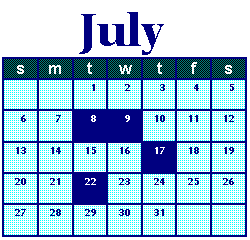 |
- Tuesday, July 8, 1997
- Iowa Administrative Rules Review Committee
10:00 a.m., Room 116
- Wednesday, July 9, 1997
- Iowa Administrative Rules Review Committee
9:00 a.m., Room 116
- Thursday, July 17, 1997
- County Issuance of Motor Vehicle Licenses Study Committee
10:00 a.m., Room 118
- Tuesday, July 22, 1997
- Fiscal Committee of the Legislative Council - TENTATIVE
Time and Location to be Announced
|
County Issuance of Motor Vehicle Licenses Study Committee
Chairperson: Christine Van Meter, Polk-Des Moines Taxpayers Association
Vice Chairperson: Richard Johnson, Auditor of State
- Cost Subcommittee Meeting:
- Location: Room 1, Date & Time: Tuesday, June 17, 1997, 9:00 a.m.
- Technology Subcommittee Meeting:
- Location: Room 1, Date & Time: Tuesday, June 17, 1997, 1:00 p.m.
- Quality Subcommittee Meeting:
- Location: Room 1, Date & Time: Wednesday, June 18, 1997, 10:00 a.m.
Chairperson: Representative Chuck Gipp
Vice Chairperson: Senator Stewart Iverson, Jr.
- Location: Room 24
- Date & Time: June 25, 1997, 10:30 a.m.
- LSB Staff: John Pollak, Michael Goedert
- Agenda: To Be Announced
Chairperson: Representative Brent Siegrist
- Location: Room 24
- Date & Time: June 25, 1997, 11:30 a.m.
- LSB Staff: Ed Cook, Diane Bolender
- Agenda: To Be Announced
Chairperson: Senator John Jensen
Vice Chairperson: Representative Chuck Gipp
- Location: Room 24
- Date & Time: June 25, 1997, 1:00 p.m.
- LSB Staff: Thane Johnson, Ed Cook
- Agenda: To Be Announced
Chairperson: Senator Stewart Iverson, Jr.
Vice Chairperson: Speaker Ron Corbett
- Location: Room 116
- Date & Time: June 25, 1997, 2:00 p.m.
- LSB Staff: Thane Johnson, Diane Bolender
- Agenda: To Be Announced
Vice Chairperson: Representative Christopher Rants
- Location: Committee Room 116, State House, Des Moines
- Date & Time: Tuesday, July 8, 1997, 10:00 a.m.
Wednesday, July 9, 1997, 9:00 a.m.
- LSB Staff: Kathie Bates, Administrative Code Office
- Contact Person: Joe Royce, Legal Counsel, Administrative Rules,
- Agenda: Agenda Published in the Administrative Bulletin
County Issuance of Motor Vehicle Licenses Study Committee
Chairperson: Christine Van Meter, Polk-Des Moines Taxpayers Association
Vice Chairperson: Richard Johnson, Auditor of State
- Location: Room 118
- Date & Time: Thursday, July 17, 1997, 10:00 a.m.
- LSB Staff: Mike Kuehn, Jan Simmons
- Agenda: To Be Announced
Co-chairperson: Senator Derryl McLaren
Co-chairperson: Representative David Millage
- Location: Speaker's Conference Room, State House, Des Moines
- Date & Time: Tuesday, July 22, 1997 - TENTATIVE
- LFB Staff: Tim Faller, Holly Lyons
- LSB Staff: Patty Funaro
- Tentative Agenda: To Be Announced
June 4, 1997
1st Meeting of the 1997-1998 Biennium
Revenue Update. Mr. Dennis Prouty, Director, Legislative Fiscal Bureau, provided a revenue update. He informed the Committee that the projected ending general fund balance prior to cash reserve transfers for FY 1997-1998 is approximately $251 million. He reported that there were no item vetoes that affected the general fund appropriations but that item vetoes totaling $730,000 were made in appropriations from the Rebuild Iowa Infrastructure Fund for FY 1997-1998.
Lottery Update. Mr. Dennis Prouty, Director, and Mr. Jeff Robinson, Legislative Fiscal Bureau, informed the Committee that the current projection for the amount of Lottery profit transfer to the general fund for FY 1996-1997 is approximately $2.6 million below the Revenue Estimating Conference (REC) estimate.
Sales Tax Revenue and Income Tax Refunds. Mr. Jon Muller, Legislative Fiscal Bureau, provided information regarding sales tax collections and income tax refunds. Mr. Muller noted that the (REC) had reduced the sales tax revenue estimate for the amount of increase over fiscal year 1995-1996 at the April meeting from 5.1 percent to 3.9 percent. He explained that the reduction could be due to a number of factors including factors relating to the payouts of the local option sales tax, sales tax trends, other tax sources, and economic considerations. In regard to income tax refunds, Mr. Muller reported that the REC estimated at the April meeting that FY 1996-1997 refunds would total $387.9 million and that even though refunds are being processed at a slower rate than the previous year, the amount being refunded is in keeping with the estimate.
Federal Update. Mr. Phil Smith, State/Federal Office, Washington D.C., provided an update of federal activity via conference call. Mr. Smith discussed the federal Budget Agreement currently being finalized. He noted that the Budget Resolution provides for two budget reconciliation bills including one for tax changes and one for entitlements. He noted that the main elements of the proposed tax changes include a $500 child tax credit, a reduction in the capital gains rate, additional higher education tax breaks, a reduction in the estate tax, an expansion in Individual Retirement Accounts (IRAs), and offsets with revenue-generators.
In the area of entitlements, Mr. Smith discussed changes proposed in the areas of Medicaid, Medicare, Transportation, Welfare, and Education. He also briefly noted other major federal issues including transportation, workforce state grant programs, education for disabled students, public housing, and juvenile justice.
Appropriations Transfers. Ms. Holly Lyons, Legislative Fiscal Bureau, noted that proposed transfers to the Division of Criminal Investigation of $40,000 from the Division of Administrative Services and the Division of Capitol Police within the Department of Public Safety for the costs of cases in the state crime lab, riverboat law enforcement, and overtime in other law enforcement activities. She noted an additional transfer to the Department of Revenue and Finance, State Financial Management Division of $525,000 from the Department of Revenue and Finance, Compliance Division and Internal Resource Management, for cost allocation of equipment maintenance, printing, postage, information technology reimbursements, and Attorney General reimbursements across all divisions.
Lease Purchase Notifications. Mr. David Reynolds, Legislative Fiscal Bureau, discussed two lease-purchase notifications. The Department of Human Services submitted a lease-purchase notification for energy improvements at the Eldora State Training School of $297,008 and the Department of General Services submitted a lease-purchase notification to refinance six Xerox copiers at a total cost of $348,876.
Mr. Reynolds also discussed the change in the procedures used by state agencies to enter into lease-purchase agreements. Prior to the enactment of legislation in 1996 which changed the procedure, state agencies were required to notify the Fiscal Committee 30 days in advance of entering into a lease-purchase agreement. The new law requires instead that centralized financing of lease-purchase agreements is based in the Office of the Treasurer of State rather than the Department of General Services, that the total principal amount of a lease-purchase agreement entered into by the Treasurer of State on behalf of a state agency is $1.0 million, and that any agreement in excess of $1.0 million must be approved by the Governor and by the General Assembly or by the Legislative Council if the General Assembly is not in session. The new law also increased the amount that the Iowa Telecommunications and Technology Commission may spend for purchase, lease, or lease-purchase of property and services from $500,000 to $1.0 million. The new law provisions do not apply to the Board of Regents, or lease-purchase agreements relating to energy conservation improvements or funded through the Department of Transportation's Materials and Equipment Revolving Fund. Mr. Reynolds proposed four options to expedite the lease-purchase process when approval is required by the Legislative Council since the Legislative Council does not meet on a regular basis. The Fiscal Committee approved submitting the four options to the Legislative Council for consideration with the priority of the Fiscal Committee for the Legislative Council to delegate the authority for approval of lease-purchases to the Fiscal Committee.
Iowa Communications Network Update. Mr. Doug Wulf, Legislative Fiscal Bureau, provided a fiscal update on the Iowa Communications Network (ICN). He noted that currently the ICN is approximately $700,000 over budget due mainly to the costs of electronic messaging. He noted that there are currently 442 full-motion interactive video classrooms, provided current hourly video service rate increases, and noted that at the September commission meeting the commission will discuss changes in rate structure options so that future subsidization of video usage will no longer be necessary.
Health Insurance Premiums Overcollection. Mr. Larry Sigel, Legislative Fiscal Bureau, discussed the report by Blue Cross and Blue Shield, the primary health insurer for current and former state employees, of an overcollection of premiums for former state employees due to an accounting error. The error was discovered during the normal auditing process. Former state employees pay the total cost of their health insurance to Blue Cross, Blue Cross collects the premiums and distributes them back to the State, and the State remits the payment for the premium costs of both current and former state employees to Blue Cross. Blue Cross had collected the correct amount from the former state employees but remitted a smaller amount to the state. The total amount of $12.4 million includes $10.9 million in premiums which were not remitted to the state and $1.5 million in interest on the nonremitted amount.
Oversight Committee. Representative Libby Jacobs discussed a proposal for creating an oversight committee under the Legislative Council pursuant to legislation enacted in the 1997 session. She noted that under the proposal, the committee will have 10 members, will meet no more that once a month, and will review the program side of various issues which come before the committee. Proposed areas for review include monitoring the year 2000 change in state computer systems, monitoring the technology needs of the state on an ongoing basis, reengineering state government, considering the possibility of reconvening the Governor's Committee on Government Spending Reform (known as the "Fisher Commission") and reviewing the area education agencies (AEAs). Representative Jacobs noted that the Department of General Services has awarded a contract to CTA Incorporated for year 2000 services.
1997 Interim Issues. The members of the Committee proposed the following possible areas of review for the Fiscal Committee during the 1997 Interim:
- Education, including AEAs, implementation of Phase III of the Education excellence Program, school fees, and visits to all state regents institutions.
- Prison site visits.
- Tax increment financing (TIF) districts, including the costs of education which are paid by the state in these areas.
- Judicial Branch review, including a review of the disparity across the state of collection of fines.
- Human services, including a review of the RFP process for managed care.
- Housing, including a review of the private housing corporation.
- Relocation of employees/departments in the capitol complex.
- Livestock as an economic development issue.
- Follow-up on the health insurance audit and state auditing practices.
- Follow-up on the Year 2000 computer system changes.
- Juvenile Justice cost-savings.
- Blufflands.
Next Meeting. The Committee selected July 22, 1997, as the next meeting date of the committee with an agenda for the meeting to be forthcoming.
- LSB Monitor: Patty Funaro
June 5 and 6, 1997
Overview. A program entitled "A Governor's Conference on Iowa's Emerging Health Issues, A Barn Raising for Public Health: Building on Iowa's Heritage in the 21st Century" was held at Drake University on June 5 and 6, 1997. The conference was jointly sponsored by the Iowa Governor's Office, the Iowa Department of Public Health, and the Drake University Center for Health Issues, and was organized with the fundamental goal of developing plans for use by local government and health officials, together with community residents, to ensure that the health system in Iowa will protect citizens of the state well into the twenty-first century.
Session Objectives. Participants discussed ways to assure that population health needs are met amid rapid changes in health care and government, how private-public partnerships can strengthen population-based health, collaborating and networking techniques from community-based model programs, health priorities and key emerging health issues that must be addressed to meet current and future health needs, technical, legal, organizational, and revenue changes needed to strengthen the capacity of public health to address challenges to community health, and recommendations to improve public health and advance a prevention agenda, with the ultimate objective of becoming empowered to return to their communities and positively impact the future of community health.
Presentations. Program presentations included the following:
- Setting the Public Health Agenda for the 21st Century. Dr. John C. Lewin, Chief Executive Officer and Executive Vice President, California Medical Association, discussed his involvement with the public health programs in Hawaii and California, and the challenges and opportunities facing Iowa as the twenty-first century begins.
- Showcasing Local Partnerships. Janan Wunsch, Rural Health Demonstration Project Site Coordinator, discussed and profiled local community private-public health care partnerships.
- Public Health and Health Plans: Can There Be a Viable Partnership? Gail L. Warden, President and Chief Executive Officer, Henry Ford Health System, discussed the restructuring of the health care delivery system in response to changes in the way in which health services are being financed, and issues relating to the formation of partnerships with public health.
- Strengthening the Health Delivery System. A panel comprised of Congressman Greg Ganske, Senator Charles Grassley, State Senator Mary Kramer, Dr. Stephen C. Gleason, White House Health Advisor, Dr. Robert Kelch, Dean, University of Iowa College of Medicine, and Merle Pederson, Counsel, Principal Financial Group, discussed ideas and methods for improving health care delivery in Iowa, and responded to questions relayed by chair Tom Slater, President, State Public Policy Group.
Workshops and Breakout Sessions. Conference attendees were given the option of attending three workshops -- Grant Writing, Using the Internet to find Health Resources, and Community Development for Health: Hometown Health. Individuals not registering for a workshop were divided into breakout session discussion groups focusing on two topics -- Mobilizing the community for Health and Creating Quality in the Health System. Discussion groups arrived at recommendations and constructed models relating to their topics, and also developed questions for submission to a panel during the final session of the conference.
June 9, 1997 - First Meeting
Background. The Committee was created by 1997 Iowa Acts, House File 372, to study, make recommendations regarding, and, if such a system is enacted, oversee the implementation of a uniform system for the issuance of motor vehicle licenses by county treasurers. The Committee is to study the experience of the six counties (Adams, Cass, Fremont, Mills, Montgomery, and Page) currently authorized to issue motor vehicle licenses, take testimony from the State Department of Transportation, survey customers in the six counties and other interested parties, make a cost comparison between issuance of licenses by the department and by the counties, recommend guidelines for all driver's license activities, and make recommendations regarding driver's license issuance activities. The Committee is to report to the General Assembly not later than January 1, 1998, and shall act in an advisory capacity regarding implementation of a county issuance program, should one be enacted, until December 21, 1998.
Membership. Committee membership consists of five county treasurers chosen by the Iowa Association of County Treasurers; the Director of the State Department of Transportation, Director of the Office of Driver Services of the State Department of Transportation, Director of Audits for the State Department of Transportation, Executive Director of the Iowa Motor Truck Association, Auditor of State, and Executive Director of the American Automobile Association of Minnesota/Iowa or their designees, and the certified public accountant and the operations research analyst who are members of the County Finance Committee.
Actions. The Committee elected Ms. Chris Van Meter as chairperson and Auditor of State, Richard Johnson or his designee as vice-chairperson and adopted rules. The committee took the following actions:
- Agreed to request funding for the customer survey at the July meeting of the Legislative Council.
- Discussed the goals of the Committee and agreed that the Committee would try to make its recommendations not later than December 1, 1997, and that the Committee would strive to reach a consensus on its recommendations.
- The committee discussed several issues which will need to be considered including quality of service issues, cost, and technology. The Committee agreed to form three subcommittees a cost subcommittee, a quality and survey subcommittee, and a technology subcommittee.
Future Meetings.
- The next two meetings of the Committee are tentatively scheduled for July 17, 1997, at 10:00 a.m., in Room 118 of the Capitol and August 13, 1997, at 1:00 p.m., in Room 19 of the Capitol.
- The Cost Subcommittee will meet on June 17, 1997, at 9:00 a.m., in Room 1 of the Capitol.
- The Technology Subcommittee will meet on June 17, 1997, at 1:00 p.m., in Room 1 of the Capitol.
- The Quality Subcommittee will meet on June 18, 1997, at 10:00 a.m., in Room 1 of the Capitol.
- Agendas for all listed meetings are to be announced.
- LSB Staff Contacts: Mike Kuehn, Jan Simmons
June 10, 1997
- ETHICS AND CAMPAIGN DISCLOSURE BOARD
- Gifts to campaign volunteers, 351 IAC subrule 4.6(1), 5-7-97 IAB, pg. 1799, NOTICE.
The committee gave a preliminary review to a proposal relating to campaign volunteers. Current rules allow only a token gift, limited to volunteer workers. Under the proposal, cash or gifts up to $250 in value may be given to any campaign worker, for the most recent election cycle. Board representatives noted that the $250 figure is merely a starting point, which may later be adjusted up or down as experience dictates. Those representatives also cautioned that candidates should consider whether they will use paid staff, because once the decision is made to use only volunteers, the candidate cannot later decide to provide any gift larger than that specified in the rule.
Action. Committee members expressed general support for this change. The committee will review this provision a second time after its adoption in final form.
- DEPARTMENT OF ELDER AFFAIRS
- Assisted living programs, 321 IAC Ch. 27, 5-21-97 IAB, pg. 1882, ADOPTED.
Iowa Code Chapter 231C authorized the creation of "assisted living programs"; these programs provide housing in conjunction with a variety of health and homemaker services which allow clients to maintain at least a modicum of independent living. These homes are renovated private homes, located in residential areas, and must be either voluntarily accredited by a national program or certified by the Department of Elder Affairs. Department officials have noted that the expense of accreditation under the national program will likely result in most facilities opting to be regulated by the state.
Action. These final rules have now been accepted by the committee, and support for these rules was voiced by a number of care providers groups. The program does retain some controversy. At issue was the location of these facilities in residential neighborhoods. A number of communities protested the lack of local control over the location and renovation of these homes. While these problems remain, it was noted that 1) the statute, not the rules grants these facilities their high level of independence from regulatory control; and 2) this particular type certification was not the type used in the current controversy. It was also noted that certification was applicable to homes with six or more beds, meaning that a facility with fewer beds might not even be regulated by the state in any fashion.
- ENVIRONMENTAL PROTECTION COMMISSION
- Regents tire burning program, 567 IAC Ch. 216, 5-21-97 IAB, pg. 1887, ADOPTED - DELAYED.
Iowa Code section 455D.11C establishes a management fund based on a $5.00 surcharge imposed for the issuance of a certificate of title. The EPC will dispense some $100,000 annually to help fund the use of old tires as a heating fuel at Iowa's state universities. Representatives from the University of Iowa power plant contend that labor and equipment allowances are inadequate to meet the increased costs. That rule limits reimbursement for increased labor costs to 25 percent of the difference between rubber-blended fuel and the primary fossil fuel. Board representatives noted that blending the fuel and removing bits of steel belts from the mix is a labor intensive effort that far exceeds the 25 percent limit. The university representatives contend the best solution would be to simply reimburse the institution for actual costs. Representatives from the EPC responded that Iowa Code section 455D.11E closely limits their flexibility to reimburse actual cost.
Action. Committee members felt the best solution would be for the University of Iowa and the Environmental Protection Commission to discuss this issue further and report back to the committee in July. Committee members imposed a seventy day delay on this filing, noting that it could be lifted at the July 8th meeting if agreements are reached.
- DEPARTMENT OF HUMAN SERVICES
- Child Care eligibility, 441 IAC Ch. 130 & 170. Filed emergency, SELECTIVE REVIEW.
Amendments relating to child day care were controversial. House File 715, section 9(3) states in part: "Based upon the availability of the funding provided in subsection 2 the department shall establish waiting lists for state child care assistance in descending order of prioritization as follows_Families with an income at or below 155 percent of the federal poverty level with a special needs child as a member of the family." To implement this provision the department emergency adopted amendments to its rules chapter 441 IAC 130; the rules added two additional groups to the 155 percent eligibility level: families who were receiving child care as of June 30,1993, and families who have received transitional child care for 24 consecutive months.
Discussion. Question was raised whether House File 715 authorized these two groups at the 155 percent level, since the Act itself referred only to special needs children. It was noted that child care assistance to the two other groups was authorized only in 1993 by intent language set out in session law; however, that intent was never codified or reenacted into statute. The department responded by noting these two groups had been kept at the 155 percent level since 1993 in department rule. Next the department noted that the actual rule change itself did nothing more than increase the actual dollar levels themselves to current federal levels; department representatives contended that House File 715, section 9(3) clearly states that the poverty level is to match federal guidelines.
Action. The committee was unable to immediately resolve this issue. For many years intent language has been used to create new programs which are implemented through rulemaking; generally speaking, the department's broad grant of rule-making authority is adequate to maintain those programs. However it is debatable whether the emergency rule-making power granted on an annual basis to speed the implementation of newly legislated policy should be used to update or amend current policy. The committee voted to refer this issue to the General Assembly for further study, but did not delay the implementation of this new policy. This issue will be discussed again by the committee at its July 8th meeting.
- MORTUARY SCIENCE EXAMINERS
- Licensure of funeral directors and crematories, 645 IAC ch. 100, 5-21-97 IAB, pg. 1898, ADOPTED.
These rules relate generally to the practice of mortuary science and the operation of crematories. The initial noticed rules were controversial because they required licensed funeral directors to pick up bodies; this was controversial with smaller funeral homes, who often have only one director on staff. The issue was solved by House File 335 which expands the existing law to allow the medical examiner and emergency medical services to transport bodies. In essence this allows smaller funeral homes to contract with the local ambulance service to pick up bodies when the funeral director is unavailable. In response to public comment the board also agreed to make additional changes relating to situations where the body is taken directly from the place of death to a crematory; the changes will clarify that in these situations, the services of a funeral director are not needed.
Action. The committee took no adverse action on these rules.
- IOWA WORKFORCE DEVELOPMENT
- Unemployment appeals process, 871 IAC Ch. 24, 486 IAC Ch. 3, SELECTIVE REVIEW.
At the request of Senator Steve King the committee generally reviewed the appeals process for unemployment benefits.
- LSB Staff: Kathie Bates, Administrative Code Editor
- Contact Person: Joe Royce, Legal Counsel, Administrative Rules
June 11, 1997
Background. Members of the Commission on Educational Excellence for the 21st Century were appointed by Governor Branstad on February 27, 1997, with the objective of developing a vision and roadmap for educational excellence for pre-kindergarten through grade twelve students in the 21st century. The fourth meeting of the commission took place on June 11, 1997, at the Grant Wood Area Education Agency in Cedar Rapids, Iowa. Highlights of the meeting are as follows:
Area Education Agency Services To Local School Districts. Dr. Ronald Fielder, Chief Administrator, Grant Wood Area Education Agency, presented an overview of the development of the area education agency (AEA) system in Iowa and the services which AEAs provide. Included within the overview was a discussion of why AEAs were established, similarities and differences with other states, and AEA funding, governance, purpose, and scope. Dr. Fielder also discussed the role of AEAs in providing special education services, media and technology services, educational services, professional staff development, accreditation services, and the relationship between the AEA's and the state Department of Education and the local districts within each AEA region.
Instruction And Achievement. An Overview Of International Benchmarking. Dr. Gilbert Valverde, Michigan State University Department of Education, discussed the development and results of the Third International Mathematics and Science Study. The presentation focused on a comparison between United States fourth and eighth grade achievement results and the results obtained in other countries -- primarily Japan and Germany. The United States results were higher for fourth grade students than for eighth grade students when compared to students from other countries, but at both grade levels performance was ranked somewhere in the middle in comparison to other countries in general, and substantially lower than Japan and Germany. Possible explanations for this cited by Dr. Valverde included a broad spectrum of topics being instructed within a subject area in limited depth in the United States versus a narrower and deeper focus in other countries, an unfocused curriculum, and a lack of standardization regarding subject matter instruction and achievement levels.
Work Group Deliberations And Reports. Commission members and workgroup participants have previously been assigned to one of four focus groups. Topics for the workgroups are Student Achievement, Quality of Instruction, Parent and Community Involvement, and High Expectations for Students. Workgroups met to make recommendations for a final draft of a vision document, and made reports to commission members of the outcome of their sessions. Preliminary recommendations included:
- Student Achievement -- defining standards for student achievement, providing models for school districts utilizing multiple assessment tools, defining achievement data for districts to report to the state, and committing support system resources to assist in making changes.
- High Expectations for Students -- focusing on literacy, communication, numerical fluency, and citizen skills.
- Parent and Community Involvement -- focusing on improving communication between parents and schools, improving school access to non-students, creating school-community partnerships, time and resource issues for instructional and support staff, planning, evaluation, and accountability issues regarding the role of the state and the local school district, and teaching communication skills.
- Quality of the Instructional Program -- emphasizing quality of learning versus instruction, teacher quality, recruitment, accreditation, and mentoring, creative utilization of existing time, a realignment or restructuring of areas not currently under the Department of Education, and a demonstration of uniform AEA effectiveness and increased accountability.
Next Meeting. The next meeting of the Commission on Educational Excellence for the 21st Century is scheduled for July 21, 1997.
 Iowa General Assembly
 Search: 1997 Interim (77th General Assembly)
© 1997 Cornell College and
League of Women Voters of Iowa
Comments about this site or page?
webmaster@legis.iowa.gov.
Please remember that the person listed above does not vote on bills. Direct all comments concerning legislation to State Legislators.
Last update: Fri Jun 20 17:50:03 CDT 1997
URL: /DOCS/GA/77GA/Interim/1997/calendar/970616.htm
sw