
![[Dome]](../../dome.gif) Interim
Calendar and Briefing
Interim
Calendar and Briefing
December 24, 1996
- Contents:
- Calendar of Scheduled Meetings
- Agenda Information Regarding Scheduled Meetings
- BRIEFINGS - Information Regarding Recent Meetings
 |
|
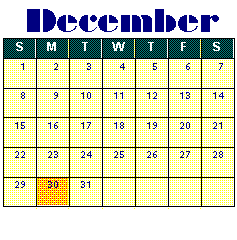
- Monday, December 30, 1996
- Judicial Compensation Commission
10:00 a.m., Room 116
|
 |
|
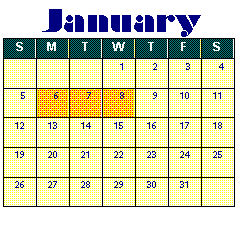
- Monday, January 6, 1997
- ADMINISTRATIVE RULES REVIEW COMMITTEE
10:00 a.m., Room 118
- Tuesday, January 7, 1997
- ADMINISTRATIVE RULES REVIEW COMMITTEE
9:00 a.m., Room 118
- FISCAL COMMITTEE OF THE LEGISLATIVE COUNCIL - (TENTATIVE)
10:00 a.m., Room 22
- Wednesday, January 8, 1997
- Iowa Administrative Procedures Study Committee
10:00 a.m., Room 116
|
- Location: Room 116, State House, Des Moines
- Date & Time: Monday, December 30, 1996, 10:00 a.m.
- Staff: Leslie Hickey, Mike Kuehn
- Tentative Agenda: Agenda to be Announced
- FURTHER INFORMATION: | CHARGE | MEMBERS | STAFF | FINAL REPORT |
Co-chairperson: Senator Berl E. Priebe
Co-chairperson: Representative Janet Metcalf
- Location: Room 118, State House, Des Moines
- Date & Time: Monday, January 6, 1997, 10:00 a.m., Tuesday, January 7, 1997, 9:00 a.m.
- Contact Person: Joe Royce, Legal Counsel, Administrative Rules
- LSB Staff: Kathie Bates, Administrative Code Office
- Tentative Agenda: Agenda (as Published in the Administrative Bulletin)
- FURTHER INFORMATION: | CHARGE | MEMBERS | STAFF | HEARINGS |
Co-chairperson: Senator Larry Murphy
Co-chairperson: Representative David Millage
- Location: Committee Room 22, State House, Des Moines
- Date & Time: Tuesday, January 7, 1997, 10:00 a.m.
- LFB Staff: Tim Faller, Holly Lyons
- Tentative Agenda: Agenda to be Announced
- FURTHER INFORMATION: | CHARGE | MEMBERS | STAFF | HEARINGS |
Co-chairperson: Senator Tom Vilsack
Co-chairperson: Representative Janet Metcalf
- Location: Room 116, State House, Des Moines
- Date & Time: Wednesday, January 8, 1997
- Staff: Ed Cook, Doug Adkisson
- Tentative Agenda: Agenda to be Announced
- FURTHER INFORMATION: | CHARGE | MEMBERS | STAFF | HEARINGS |
December 17, 1996; Second and Last Meeting
- Background.
- The Local Infrastructure Needs Study Committee met to complete its charge to assess the status of local infrastructure and the resources available to local government to provide for long-term infrastructure needs including the study of approval requirement for bond issues and recommendations for the prioritization of projects.
- Presentations.
- There were eight persons invited to present testimony to the Study Committee:
- 1995 Study. Dr. James Rowings, College of Engineering, Iowa State University, discussed the results of a statewide public infrastructure study which was conducted on behalf of the Iowa General Assembly in 1995.
- Auditor of State. The Honorable Richard Johnson, Auditor of State, proposed that an Iowa Foundation Plan for School Infrastructure be developed to bring the needs of local school facilities into condition for the technological challenges of the next century.
- School Boards. Ms. Susan Donovan, Director of Government Relations, Iowa Association of Schools Boards, presented the Association's recommendation that would allow school bond issues to be passed by a simple majority of the district voters and authorize the local school board to levy a combination of property taxes and income surtaxes to repay the indebtedness. The Association also supports legislation which would include local governments, AEAs, and community college in state infrastructure funding.
- State Fire Marshal. Mr. Roy Marshall, State Fire Marshal and State Building Code Commissioner, reported that approximately 10 percent of the K-12 school buildings have serious fire safety deficiencies. He noted also that approximately 10 percent of the K-12 buildings have inadequate electrical systems which will not accommodate the installation of new technologies.
- Governor's Committee. Mr. Edgar Hansell, Nyemaster Law Firm and Ms. Janet Phipps, Director, Department of General Services, Co-chairpersons, Infrastructure Subcommittee of the Governor's Committee on Government Spending Reform, discussed the recommendations of the Governor's Committee regarding state infrastructure. The recommendations included refining the definitions relating to infrastructure as provided in the Iowa Code, establish a Rebuild Iowa Infrastructure Board to oversee the repair and renovation process, establish a capital asset management program, and provide separate funding for routine and preventive maintenance, and emergency repair and maintenance, repair and replacement, renovation, and new construction.
- County Views. Ms. Cris Plocher, Iowa Association of Counties, and Mr. Harry Graves, Executive Director, Buchanan County Conservation Board, urged that a state infrastructure financing program be developed to assist local capital projects. Mr. Graves noted that there are a number of county recreational facilities with structures such as low-head dams which cannot be realistically repaired or replaced with available county financial resources.
- Iowa Finance Authority. Mr. Ted Chapler, Executive Director, Iowa Finance Authority, presented several financing methods which could be used to support infrastructure projects by school districts or other local governmental agencies. These methods included a revolving fund, a write down option, and a credit enhancement option.
- Recommendations.
- During its discussion following the invited presentations, it was the consensus of the Study Committee that its recommendations should follow the direction established in the 1996 rebuild Iowa infrastructure legislation. The Study Committee adopted the following recommendations:
- That the definitions relating to the Rebuild Iowa Infrastructure Fund legislation should be amended to reflect the recommendations of the Governor's Committee on Government Spending Reform (Section 8.57, subsection 5, paragraph c, Code of Iowa). The terms include: vertical infrastructure, horizontal infrastructure, emergency repair and replacement, operations, routine maintenance, preventive maintenance, repair and replacement, deferred maintenance, new construction, and renovation.
- The Rebuild Iowa Infrastructure Fund should have a continuing source of funding.
- The Rebuild Iowa Infrastructure Fund should receive all gambling revenue exceeding the first $60 million annually and all interest transfers from reserve funds. The tax rate on the gross receipt of gambling revenue from racetrack casinos and excursion boat casinos should be increased to 36 percent of the adjusted gross receipts above the first $3 million. The proceeds of the fund should be used to support both state and local infrastructure projects.
- A local government infrastructure revolving fund should be established with an appropriation of $100 million from the State General Fund to provide supplemental funding for local government infrastructure projects. The fund should be administered by the State Capitol Planning Commission with expanded membership.
- An appropriation of $20 million annually from the State General Fund from any revenue above the first $40 million of gambling revenue to fund a 1 percent allowable growth in the school aid foundation which shall be credited to the schoolhouse fund of each K-12 public school district.
- The deficiencies identified in a report of the State Fire Marshal to the board of directors of a K-12 school district shall be included in the minutes of the the meeting at which the report was received.
- The General Assembly should provide for an update of the statewide infrastructure studies which have been completed.
- Staff: Mike Kuehn, Thane Johnson
December 18, 1996; First of Three Meetings
- Overview.
- The Local Corrections Infrastructure and Crime Prevention Review Interim Study Committee was established by the Legislative Council to review the report of the Attorney General's Corrections Planning Task Force, and to make recommendations and proposals concerning corrections, juvenile justice, and school-based infrastructure projects, including consideration of establishing a grant program and funding mechanism for these projects. The Corrections Planning Task Force met from September through December of this year, and delivered its report to the legislature on December 6.
- Report of the Attorney General's Corrections Planning Task Force.
- Attorney General Tom Miller made a presentation to the Committee regarding the final report of the Attorney General's Corrections Planning Task Force. Mr. Miller first discussed the process by which the task force obtained the information necessary to create its report. The task force held 11 outreach sessions and public hearings throughout the state in order to obtain input from local governments, agencies, and the public.
In discussing the recommendations of the Task Force, the Attorney General was assisted in his presentation by Charles Krogmeier, Chair of the Task Force. The findings of the Task Force centered upon four themes:
- County Jails: In general, the inventory of local corrections facilities in Iowa revealed that in urban areas, the primary problem is inadequate capacity. In rural areas, however, the primary problem is with the age or condition of existing facilities. All jails could benefit from greater use of technology, such as fiber-optic systems for initial appearances, sentencing, and similar matters, and from consideration of multi-county planning, including utilization of multi-county facilities.
- Juvenile Justice: A full continuum of treatment and punishment alternatives should be available for juveniles, from early intervention to adequate and appropriate capacity for juveniles adjudicated as delinquent.
- Crime Prevention: The most effective crime prevention programs are community-based and multi-organizational in approach. In addition, a state coordinator should oversee crime prevention programs.
- School-based Programs: Comprehensive school-based programs involving the combined efforts of all relevant agencies and organizations provide a model that should be expanded.
- Task Force Hearings.
- Ms. Arlinda McKeen, State Public Policy Group, made a presentation to the Committee regarding the focus groups and public hearings conducted by the Corrections Planning Task Force. Focus groups were established by invitation, and structured to provide for a guided discussion of issues and participation of all present. Public hearings primarily focused on local issues raised by sheriffs, county attorneys, citizens, or elected officials. Consistent themes discussed across the state included overcrowding in urban facilities, and age and staffing problems in rural facilities, but local issues tended to be somewhat individualized according to the location of the hearing.
- Vermont Reparative Probation.
- Ms. Jean Kuehl made a presentation to the Committee regarding the Vermont Restorative Justice Project. Restorative justice focuses more on correcting behavior and restoring the damage to the victim and the community caused by the delinquent act, and less on retribution and punishment.
Ms. Kuehl discussed the reparative board process used in Vermont and showed the committee a brief video tape regarding the process. The board provides the framework for meeting with the victim and for working out a plan for restoring the victim's or community's loss by the offender. The board determines what activities should serve as reparative activities and monitors compliance by offenders.
- Future Meetings.
- The committee members agreed, by motion and vote, to grant the co-chairpersons the discretion to set the future meeting date, which is likely to occur immediately prior to the beginning of the legislative session in January.
- Staff: Jan Simmons, Mike Kuehn
 Back to top of Interim Information
 Iowa General Assembly
 Search: 1996 Interim (76th General Assembly)
© 1996 Cornell College and
League of Women Voters of Iowa
Comments?
webmaster@legis.iowa.gov.
Last update: Thu Dec 26 15:40:03 CST 1996
URL: /DOCS/GA/76GA/Interim/1996/calendar/961224.htm
sw