
![[Dome]](../../dome.gif) Interim Calendar and Briefing
Interim Calendar and Briefing
September 18, 1996
- Contents:
- Calendar of Scheduled Meetings
- Agenda Information Regarding Scheduled Meetings
- BRIEFINGS - Information Regarding Recent Meetings
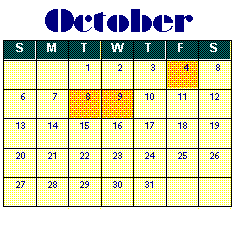 | |
- Friday, October 4, 1996
- Fiscal Committee of the Legislative Council
10:00 a.m., Room 116
- Tuesday, October 8, 1996
- Administrative Rules Review Committee -
10:00 a.m., Room 22
- Wednesday, October 9, 1996
- Administrative Rules Review Committee -
9:00 a.m., Room 22
|
Co-chairperson: Senator Larry Murphy
Co-chairperson: Representative David Millage
- Location: College of Veterinary Medicine, Alumni Room,
Iowa State University, Ames, Iowa
- Date & Time: October 4, 1996, 9:00
- LSB Monitor: Kathy Hanlon
- LFB Staff: Tim Faller, Holly Lyons
- Tentative Agenda:
- Housing
- Iowa Finance Authority
- Federal Update
- Prison Privatization
- Mitchellville Staffing
- School Improvement Technology Act Update
- FURTHER INFORMATION| CHARGE | MEMBERS | STAFF | HEARINGS |
Co-chairperson: Senator Berl E. Priebe
Co-chairperson: Representative Janet Metcalf
- Location: Committee Room 22, State House, Des Moines
- Date & Time: Tuesday, October 8, 1996, 10:00 a.m., Wednesday, October 9, 1996, 9:00 a.m.
- Tentative Agenda: Agenda (as Published in the Administrative Bulletin)
- Contact Person: Joe Royce, Legal Counsel, Administrative Rules
- LSB Staff: Kathie Bates, Administrative Code Office
- FURTHER INFORMATION| CHARGE | MEMBERS | STAFF | HEARINGS |
September 10, 1996
- Background.
- The Legislative Council established an interim study committee on Local Corrections Infrastructure and Crime Prevention Review, and authorized the Attorney General to create a state task force to prepare a report and make recommendations concerning corrections, juvenile justice, and school-based infrastructure projects, including consideration of a funding mechanism and grant program for these projects. The final report of the Corrections Planning Task Force is scheduled to be submitted to the interim study committee on December 3. The State Public Policy Group was hired as the consultant to help establish the Task Force and to conduct public hearings throughout the state.
- Initial Task Force Meeting.
- Charles Krogmeier, Deputy Attorney General and Chair of the Task Force, called the meeting to order. The Task Force is composed of 26 members, representing correctional, judicial, and citizen contingents. Task Force members first agreed on a mission statement: "To develop a report on the best opportunities available to assist local governments in meeting the infrastructure and program needs in local corrections, crime prevention, juvenile justice, and school-based programs." The Task Force then discussed the scope of its work activities, including the public hearing schedule and site selection. Finally, the Task Force engaged in an initial discussion of issues, focusing on issues involving local correctional facilities and crime prevention programs.
- Public Hearings.
- Each of the 11 local hearing sites will include two meetings: a small focus group will meet first, followed by a general public hearing. Invitations will be extended to the focus group participants in mid-September. The schedule of meetings is tentatively planned as follows: Cedar Rapids, October 15; Council Bluffs, October 8; Davenport, October 16; Des Moines, October 1; Dubuque, October 15; Emmetsburg, October 7; Fort Dodge, October 10; Marshalltown, October 2; Mount Pleasant, October 16; Sioux City, October 8; and Waterloo, October 14.
- Future Task Force Meetings.
- The next Task Force meeting will occur in Des Moines on October 1, 1996, and will likely include presentations by expert witnesses. The third Task Force meeting is scheduled for November 7, 1996, when the Task Force will review the results of the public hearings and an outline for their report.
- LSB Monitor: Jan Simmons
- Staff: State Public Policy Group
September 10, 1996
- Administrative Rules Update.
- The Commission gave final approval to administrative rules relating to Commission organization procedures. It is anticipated that these rules will be effective November 13, 1996.
- Private Vendor Internet Proposal.
- The Commission discussed the issue of private vendors providing Internet access to authorized users accessing the network. After lengthy discussion, the Commission deferred on the issue. The Chairperson and staff will work to develop proposed options for Commission at a later meeting.
- Rates and Charges.
- The Commission discussed rates to be charged for voice services, data service, and video services provided by the network. The Commission, after discussion, adopted the following hourly rates for video service to be effective July 1, 1997:
| K-12 Educational Use | $ 5.00 (no change from existing rate) |
| Higher Education Use | $ 6.00 ($1.00 increase) |
| Other Training use | $ 6.00 ($1.00 increase) |
| Telemedicine Training Use | $ 6.00 ($1.00 increase) |
| Administrative Use (State only) | $10.00 (no change) |
| Federal Agency Use | $45.00 ($5.00 increase) |
| US Postal Service Use | $45.00 ($5.00 increase) |
| Telemedicine Use | $45.00 ($5.00 increase) |
Information relating to voice and data services rates was provided, but no action was necessary regarding these rates.
- Private Colleges Waiver.
- The Commission has received requests from twelve private colleges for a waiver of the requirement to use the network for all video, data, and voice requirements of the colleges. These waivers have been submitted pursuant to Iowa Code section 8D.9. The colleges contend that the costs for certain services provided on the network are not competitive with the same services provided by another vendor and are requesting that they be allowed to contract with the other vendors for those services. The Commission declined to approve or deny the requests and is attempting to collect additional information for the purpose of making a decision on the requests.
- Fiscal Year 1998 Budget Request.
- The Commission reviewed and approved budget requests for Fiscal Years 1998 and 1999. These requests will now be submitted to the Department of Management.
- LSB Monitor: Mark Johnson
September 10, 1996
- AGRICULTURE AND LAND STEWARDSHIP DEPARTMENT
- Meat and Poultry Inspection, Iowa Code Chapter 189A. The committee first discussed Iowa's Meat Inspection Act and its impact on a small grocery store located in Iowa City.
- Background. Under the federal law, retail establishments are allowed to sell no more than 25 percent of their product wholesale (i.e. restaurants). Facilities which exceed this level must comply with much more stringent requirements. This federal provision has been made applicable to Iowa by Iowa Code section 189A.3(2) which binds the state to apply the same inspection standards that are applied by the federal government in interstate inspections.
- Action. The committee took testimony from a number of individuals supporting the local grocery and from USDA officials attending from Washington. It was ultimately the consensus of the Committee that it has no real jurisdiction in this matter since there are no allegations that the rules themselves are unreasonable or are being unfairly applied to the industry. No action was taken.
- ENVIRONMENTAL PROTECTION COMMISSION
- Manure Management Plans in Smaller Facilities, 567 IAC 65.18(1).
- Background. The committee took the unusual action of objecting to a rule based on the agency's failure to adopt an amendment to that provision which would have broadened the requirements for manure management plans. This proposed amendment was published as a notice of intended action in February 1996.
- Discussion. The subrule itself provides that certain animal feeding operations with a weight capacity over 200,000 pounds first occupied after September 22, 1995, must develop manure management plans even though these facilities do not need construction permits. The proposed amendment would have extended this requirement to cover existing facilities which are expanded beyond the 200,000 pound floor. Following the public comment period, the commission determined not to adopt this amendment.
Committee members felt the amendment is necessary to correct an inherent unfairness of the existing rules, contending that new construction and the expansion of existing facilities should be treated similarly, since both types of facilities would pose similar problems concerning the disposal of the animal waste.
- Action. Based on these considerations, the committee voted to object to the existing subrule on the grounds that it is arbitrary. Members felt there is no rational basis to treat the expansion of an existing facility any differently than the construction of a new facility. The effect of this objection is to remove the "presumption of validity" traditionally accorded to administrative rules in judicial review; meaning that the commission will have the burden of proving the validity of this subrule in the event of a court action.
- HUMAN SERVICES DEPARTMENT
- Child Abuse Assessment, 441 IAC Chapter 175.
- Background. A recent proposal to place only significant cases of abuse on the child abuse registry prompted a committee review on the question of whether a review could be conducted of those cases currently listed on the registry to determine if those cases met the current, more restrictive criteria for inclusion on the registry. Representatives from the department noted that the proposed change relating to the registry was specifically established in Iowa Code Supplement section 232.71A and currently would only apply to a limited number of counties in a pilot project; any state-wide expansion of that change would require legislative action. Those representatives also noted that the contents of the child abuse registry, and the appeal process are dictated by Iowa Code Chapter 235. The committee also heard comments from several persons currently on the registry.
- Action. The committee members felt that the entire issue should be revisited by the Legislature as a whole and voted a general referral to bring this matter before the Legislature.
- IOWA LAW ENFORCEMENT ACADEMY
- Peace Officers Assessment, 501 IAC 2.3 and 2.4, filed emergency. Initially reviewed in August, this proposal in essence provides that the credentials provided by the Academy constitute proof that a job applicant has met the requirements of a peace officer. The rule also would allow local agencies to impose higher standards than those of the academy itself. This second proposal was very controversial with some committee members who felt that a single, state-wide standard should be in place. Subsequent review assured committee members that the proposal merely facilitated officers transferring from one department to another, without compromise to the public safety.
- Action. The committee acquiesced to an emergency filing of this proposal, with a September 1 effective date.
- NATURAL RESOURCE COMMISSION
- Game Breeders, 571 IAC Chapter 13, notice. For the third time the commission proposes to limit goose hunting near ponds containing captive geese. The proposal is to limit hunting within 200 yards of a pond inhabited by captive waterfowl. The issue is that the location of a pond can result in the limitation of a neighboring property owner's right to hunt his or her own property. However, the federal regulatory authority recognizes no specific yard restriction and has issued citations up to three miles away from a pond. Committee members recognized the dilemma faced by the commission, recognizing the need to have an ascertainable standard while at the same time recognizing the rights of landowners to have free enjoyment of their property. Further review is anticipated following public hearings.
- TRANSPORTATION DEPARTMENT
- Tourist-Oriented Directional Signing, 761 IAC ch. 119, adopted.
- Background. These rules are controversial because they propose a 100 percent increase in the fees for so-called logo signs; these small blue signs display the advertisers logo, or denote local attractions, and are the only forms of advertising allowed on Iowa's highways. The Department of Transportation contends that the fee is necessary because the fee has not changed in over a decade and it is needed for the program to be self supporting. It was noted that for many years the federal government funded this program, but has not since the 1980's. Committee members still expressed concern over such a dramatic increase in cost, and also raised question whether Iowa must follow federal restrictions for which the federal government is no longer willing to pay. The committee took testimony from a business owner who noted the difficulty in directing customers to his location and the need for signing.
- Action. The committee members determined that the billboard program should be seriously reviewed in light of the elimination of federal financing and the impact on Iowa business; for those reasons the Committee forwarded this filing to the Legislature for further review.
- LSB Staff: Kathie Bates, Administrative Code Office
- Contact Person: Joe Royce, Legal Counsel, Administrative Rules
September 11, 1996, Second Meeting
- Background.
- The Governor's Committee (known as the Fisher Commission) created a work group to review state government practices. The Workgroup is co-chaired by Mr. William Vernon of the Vernon Companies and Ms. Gretchen Tegeler, Director, Department of Management.
- Technology Budgeting.
- Mr. James Youngblood, Director of State Technology Services, reviewed the technology budgeting practices utilized by his former employer, Iowa Methodist Medical Center. Mr. Bob Delaney, retired executive of the Principal Financial Group, reviewed that corporation's practices. Both described processes in which overall needs are identified and selection of major projects is negotiated among senior managers. Mr. Delaney noted that more routine technology purchases are made by operating units who generally procure by choosing from contract sources negotiated by the corporation. There was significant discussion of the merits of making technology services an "asset" item in budgets by developing a means to charge the users of the technology.
- Improvements to Annual Budgeting.
- Ms. Tegeler utilized a continuum table illustrating options used by various states to consider future financial condition during the budget process. The continuum suggests that in Iowa and most other states, multi-year financial projections are informal, independent, and informational while in some other states the projections are formal, based upon consensus, and binding. She reviewed telephone interviews with national experts on state budgeting and focused on states which issue multi-year projections on revenues and expenditures. It was noted that in Iowa, the Department of Management and the Legislative Fiscal Bureau both issue estimates of revenues and expenditures but there is not a formal, consensus-based process for multi-year projections.
- Future Meetings.
- The next meetings are scheduled for September 25 and October 8. These meetings are to complete the Work Group's recommendations to the full Governor's Committee.
- LSB Monitor: John Pollak
- Staff Contact: Dave Meyers, Department of Management
September 12, 1996, Second Meeting
Attending the meeting were Co-Chairperson Edgar Hansell and Janet Phipps, Merle Plagge, Charles MacNider, Senator Don Redfern, David Hurd, William Dikis, Richard Johnson, Bob Lester, Mike McCarville, and Charisse Yanney.
- Charge.
- The charge of the Infrastructure Subcommittee is as follows:
- Define infrastructure.
- Identify "scope" of state assets.
- Recommend a method of identification and prioritization of projects.
- Recommend methodology for allocation of resources.
- The staff distributed documents indicating infrastructure and related terms as defined in six other states, systems used to allocate reconstruction or repair dollars, and the agency and process used for infrastructure maintenance, repair, and replacement.
- Infrastructure Study.
- The Subcommittee received an extensive discussion of the Iowa Infrastructure 1995 report from Dr. James Rowings, Iowa State University. Dr. Rowings noted the significant impact which legislation on special education and physical disabilities has on public buildings and the costs of renovations needed to comply. Dr. Rowings agreed to work with Mr. Richard Johnson in providing examples of criteria and elements which should be included in a facility audit.
- Vertical Infrastructure.
- The Subcommittee also discussed the term " vertical infrastructure" at length. The definition included in section 8.57, subsection 5, as amended by House File 2421 of the 1996 Session was inadequate for the Subcommittee. The terms "maintenance", "repair", "major repair", "major renovation" and "new construction" should be further defined to satisfy the members. One point of extensive debate was whether "new construction" should include facilities which represent a new program or new policy initiative or should it be limited to replacement of a fully depreciated physical facility.
- Infrastructure Commission.
- The Subcommittee discussed what type of agency should be recommended to administer state infrastructure funds. After some discussion, a commission similar in design and powers to the State Transportation Commission was the consensus choice. The proposed commission members would be appointed by the Governor and confirmed by the Senate for six-year overlapping terms. The specific powers and duties of the proposed commission remain under discussion. These would include requirements of a project plan for each construction project and reports from each covered public agency on current maintenance programs. Engineering and architectural services would be needed to assist the proposed commission which would be attached to the Department of General Services. Future Meetings. The third and fourth meetings were set for September 25 and October 9.
- LSB Monitor: Thane Johnson
September 12, 1996
- Electronic Filing.
- Progress continues on development of software for electronic filing of campaign disclosure reports. So far, the software is only IBM-compatible, but attempts continue towards development of a Macintosh-compatible version of the software. The Board approved a License Agreement to be signed by committees that accept a copy of the software.
- Board Action.
- The Board agreed to broaden the language in Administrative Rule 4.6(1)( h) from "spouse" to "guest", regarding meal expenses that may be paid from campaign funds. The Board discussed and agreed to establish formal policies regarding gifts to campaign workers and proper use of legislative stationery. The Board also agreed to request an opinion from the Attorney General regarding Iowa's statute on campaign yard signs, in light of a recent ruling in the federal 8th circuit (Iowa is located within the 8th Circuit).
- Future Meetings.
- The next meeting of the Board will be October 10, 1996. The November meeting is tentatively planned to occur via the ICN.
September 12-13, 1996
- New Members.
- The board welcomed Ms. Charlene Fulton as a new member. One board vacancy remains.
- Director's Report.
- In his report to the board, Mr. Ted Stilwill noted that the department is consulting with the Iowa Girls High School Athletic Union and the Iowa High School Athletic Association on potential rule changes and the development of a statement of principles for athletics.
- Community College Accreditation Process Update.
- Division Administrator, Ms. Harriet Custer, provided the members with a copy of the Status Report of Iowa Community College State Accreditation Process. The board approved the 10-year accreditation of Southwestern Community College, making Southwestern the first community college to be accredited under a new pilot process. Dr. Richard L. Byerly, President of Southwestern Community College, noted that the state's new accreditation process is costly in terms of staff time and effort, and is in addition to the costs and colleges bear in undergoing the North Central Association of Colleges and Schools accreditation process.
- School Improvement Update.
- Division Administrator, Ms. Judy Jeffrey, told members of the department's efforts to provide school improvement service and assistance. The department brought certain consultants together to form a departmental school improvement team. Each team member is assigned to an area education agency as department liaison to that agency. In addition, the department has named as liaisons to AEAs consultants and staff from the following areas: special education, vocational education, Title I, Iowa Behavioral Initiative, School-to-Work, early intervention, and technical preparation. The teams will work to determine if AEAs know their school districts' strengths and weaknesses, and will coordinate school improvement efforts. This year's goal is to visit 20 percent of the school districts in each AEA.
- Department Appropriation Request.
- The department's appropriation request included the following six new appropriations: teacher shortage and diversity incentives, professional development schools, leadership development, older Iowans in schools, electronic data interchange, and the Reading Recovery Program. General Fund moneys requested for the six programs for FY 1998 totals $2,165,000.
- LSB Monitor: Kathy Hanlon
 Back to top of Interim Information
 Iowa General Assembly
 Search: 1995 Interim (76th General Assembly)
© 1996 Cornell College and
League of Women Voters of Iowa
Comments?
webmaster@legis.iowa.gov.
Last update: Mon Sep 23 12:50:04 CDT 1996
URL: /DOCS/GA/76GA/Interim/1996/calendar/960918.htm
sw