Iowa General Assembly Banner


[Dome]Interim Calendar and Briefing

September 4, 1996


Contents:
Calendar of Scheduled Meetings
Agenda Information Regarding Scheduled Meetings
BRIEFINGS - Information Regarding Recent Meetings

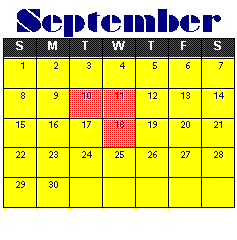
Calendar of Scheduled Meetings


Tuesday, September 10, 1996
Administrative Rules Review Committee
10:00 a.m., Room 22

Wednesday, September 11, 1996
Administrative Rules Review Committee
9:00 a.m., Room 22
Wednesday, September 18, 1996
Fiscal Committee of the Legislative Council - TENTATIVE
Time to be Announced, Ames, Iowa; ISU

Agenda Information Regarding Scheduled Meetings


Administrative Rules Review Committee

Co-chairperson: Senator Berl E. Priebe
Co-chairperson: Representative Janet Metcalf

Fiscal Committee of the Legislative Council

Co-chairperson: Senator Larry Murphy
Co-chairperson: Representative David Millage


BRIEFINGS - Information Regarding Recent Meetings


GOVERNOR'S COMMITTEE ON GOVERNMENT SPENDING REFORM -- INFRASTRUCTURE WORK GROUP

August 22, 1996

Charge.
The Infrastructure Work Group of the Governor's Committee on Government Spending Reform (also known as the "Fisher Commission") held its first meeting and the charge of the Subcommittee was distributed. The charge of the Work Group is as follows:
State Infrastructure Fund.
Mr. Lynn Barney, Department of Management, presented an overview of the State's capital budgeting plan. Prior to 1995, the State had virtually no capital budget. The Rebuild Iowa Infrastructure Fund was established in the 1994 Legislative Session by the General Assembly. Later enactments provided interest from the State's reserves as an ongoing revenue source for the Fund. This is expected to yield approximately $20 million annually. In the 1995 Session, the General Assembly made a one-time appropriation of $50 million to the fund. In 1996, Mr. Barney reported, the Governor approved legislation providing that gaming revenues in excess of $60 million will annually be deposited into the Fund.
Regents Institutions.
The Work Group also heard presentations from a representative of the Board of Regents and representatives of the three Regents universities, the University of Iowa, Iowa State University, and the University of Northern Iowa, on the capital planning process employed by the Regents and the Regents' institutions. It was stated that capital planning and prioritization of projects is often driven by academic or student needs. For each of the universities, the final decision on priority is made by the president and vice-president of the particular university.
Department of Transportation.
A representative of the Iowa Department of Transportation explained its method of prioritization of road projects, which is based on a mathematical weighting formula. The Department also described the function of the DOT Commission, a citizen-member body which determines prioritization of projects.
Department of General Services.
Ms. Janet Phipps, Director of the Department of General Services and Co-chair of the Subcommittee, informed the Work Group that, currently, each State department performs its own assessment of its capital needs and prioritization with assistance from the Department of General Services. Then, each department submits its infrastructure request to the Department of General Services. Ms. Phipps stated that the Department of General Services does maintain an inventory of State buildings and a history of major maintenance and construction.
Work Group Discussion.
The Work Group identified several issues for further exploration, including whether technology should be included in the definition of infrastructure and whether local government capital needs should be addressed with state revenues and should be included in any State capital needs assessments, and the types of infrastructure plans currently being utilized by other states. It was agreed that each member should identify in a letter to Ms. Phipps other related issues that merit further exploration.
Future Meetings.
The Work Group agreed on the following three meeting dates:

FISCAL COMMITTEE OF THE LEGISLATIVE COUNCIL

August 28, 1996

Meeting Places.
The Committee held the morning portion of the meeting at the State Mental Health Institute near Independence. The afternoon portion of the meeting was held at the University of Iowa. An optional tour of the Oakdale Correctional Facility completed the days' agenda.
Revenue Update.
Mr. Dennis Prouty, Director of the Legislative Fiscal Bureau (LFB), reported. As of August 27, revenue receipts were 7.2 percent greater than the receipts at the same time in the previous fiscal year.
Welfare Reform.
Mr. Larry Sigel, LFB, provided a brief overview of the recently enacted federal welfare reform legislation (HR 3734) and early estimates as to its potential fiscal impact on the state. The legislation is very comprehensive and could change other human services programs in addition to Iowa's Family Investment Program. Meetings involving state executive and legislative branch officials as well as federal officials are upcoming in Washington, D.C. and other places to assess potential impacts. Major points of the presentation and discussion include:
Mental Health Contract.
The state Medicaid (Title XIX) program has contracted with Merit Behavioral Care (MBC) Corporation to manage mental health services to persons in the program. Mr. Jon Neiderbach, LFB, and Ms. Candace Nardini, Department of Human Services (DHS), described recent activities associated with MBC and renewal of the contract. Some of the most important items:
Mental Health Institutes (MHIs).
An overview of the state MHIs was provided by Mr. Harold Templeman, DHS, and Dr. Bhaskar Dave of Independence MHI. Ten-year trend information indicates an overall reduction in admissions to MHIs with the greatest reduction in substance abuse admissions. Discussion centered on the cost-effectiveness of the institutions, relationship with private sector services, examples of facility sharing at MHIs, and creation of specialized programs in recent years. Committee members toured the facilities before departing for Iowa City.
Project Tours at the University of Iowa.
The renovation, fire safety and deferred maintenance needs of the university were explained by University of Iowa President Mary Sue Coleman, Director of Planning & Administrative Services Richard Gibson, and Professor and Chair of Biological Sciences Gary Gussin. Director Gibson and Professor Gussin described work planned for, in process, or completed in certain buildings on the university's campus, and afterward invited the Committee to tour the buildings. The tour included the following:

GOVERNOR'S COMMITTEE ON GOVERNMENT SPENDING REFORM -- BUDGET PRACTICES WORK GROUP

August 28, 1996

Background.
The Governor's Committee (known as the Fisher Commission) created a work group to review state government practices. The Workgroup is co-chaired by Mr. William Vernon of the Vernon Companies and Ms. Gretchen Tegeler, Director, Department of Management. The Workgroup reviewed its amended mission statement and the tentative flow chart on activities of workgroup.
Current Budgeting Process.
Discussion centered on the present budgeting process and changes contemplated. Ms. Tegeler stated that the Governor made item vetoes in order to prevent expenditures in future years (3 or 4 years in the future) from exceeding revenue projections which were developed by the Department of Management but not issued to all parties involved in the appropriations process. A discussion ensued on how a mechanism could be established for joint forecasting of out year revenues and expenditures.
Budgeting for Results.
A presentation was made on a new budget system (Budgeting for Results) which is part of the Council on Human Investment's charge to develop and implement an overall strategy to build greater accountability in government. This strategy includes:
It was noted that two items are important to the implementation of this new budgeting system. One, is to have policymakers championing the concept and the second is provide time to implement.
Information Technology Budgeting Process.
Discussion centered on the current process to budget requests for information technology needs and possible options, with pros and cons to each, to change this process. Under the current process, each agency in preparation for an approaching legislative session assembles a proposed budget for the upcoming fiscal year which consists of a number of requests for funding. Funds are typically requested for different agency purposes including administrative, programmatic, or information technology (IT). For IT requests, there is little central coordination among agencies. Generally, each agency self-determines its needs and justifies (to the Governor and General Assembly) its own IT needs and pursues funding accordingly. The current process requires that the merits of individual funding requests within a particular agency be weighed against each other. This forces IT requests to compete for funding with other agency funding requests. Frequently, programmatic funding is favored and agency IT needs are not funded. This hampers the agency's ability to more effectively deliver services through IT advancements.
The discussion involved the possibility of establishing a dedicated funding source, who would make priority decisions on requests, and the feasibility of some sort of centralization of requests. In addition, discussion focused upon the recent executive branch efforts to consolidate state data centers and the standardizing of workstations and equipment.
Next Meeting.
The next meeting was set for Wednesday, September 11.

EDUCATION TELECOMMUNICATIONS COUNCIL

August 28, 1996

Background.
The Education Telecommunications Council is established in Iowa Code section 8D.5 for the purpose of establishing scheduling and site usage policies for educational users of the Iowa Communications Network (ICN), coordinating the activities of the regional telecommunications councils, developing proposed rule changes for recommendation to the Iowa Telecommunications and Technology Commission, and recommending long-range plans for enhancements needed for educational applications.
ICN Authorized User Study Update.
The Council was informed that the State Public Policy Group, which is assisting the ICN Authorized User Task Force, has distributed approximately 3,000 surveys relating to who is using the network and for what purposes. The results of the survey will be used by the Task Force to develop recommendations to be provided to the Iowa Telecommunications and Technology Commission (ITTC) for the purpose of assisting the Commission in developing rules relating to the use of the network. The Task Force is scheduled to conduct meetings on September 20 and October 25.
ICN Video Rates.
The Council voted to send a letter to the ITTC urging that video rates for educational users be maintained at the current level of five dollars an hour. The ITTC is scheduled to begin review of network rates for the 1997-98 school year at its September 10 meeting.
Regional Telecommunications Councils Funding Recommendation and Other Legislative Proposals.
The Council approved legislative proposals including funding for the regional telecommunications councils, establishment of a spare parts depot, and funding for those districts connected to the network through the use of alternative technology to provide a T-1 connection.
Next Meeting.
The next Council meeting is scheduled to be held on September 27, 1996, at Iowa Public Television.

Back to top of Interim Information


Return To Home Iowa General Assembly

index Search: 1995 Interim (76th General Assembly)

© 1996 Cornell College and League of Women Voters of Iowa


Comments? webmaster@legis.iowa.gov.

Last update: Fri Sep 13 11:40:04 CDT 1996
URL: /DOCS/GA/76GA/Interim/1996/calendar/960904.htm
sw