
![[Dome]](../../dome.gif) Interim Calendar and Briefing
Interim Calendar and Briefing
August 8, 1996
- Contents:
- Calendar of Scheduled Meetings
- Agenda Information Regarding Scheduled Meetings
- BRIEFINGS - Information Regarding Recent Meetings
 | |
- Tuesday, August 13, 1996
- Administrative Rules Review Committee
10:00 a.m., Room 22
- Wednesday, August 14, 1996
- Administrative Rules Review Committee
9:00 a.m., Room 22
|
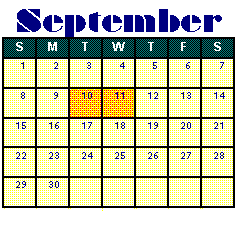 | |
- Tuesday, September 10, 1996
- Administrative Rules Review Committee
10:00 a.m., Room 22
- Wednesday, September 11, 1996
- Administrative Rules Review Committee
9:00 a.m., Room 22
|
Co-chairperson: Senator Berl E. Priebe
Co-chairperson: Representative Janet Metcalf
- Location: Committee Room 22, State House, Des Moines
- Date & Time: Tuesday, August 13, 1996, 10:00 a.m., Wednesday, August 14, 1996, 9:00 a.m.
- Tentative Agenda: Agenda (as Published in the Administrative Bulletin)
- Contact Person: Joe Royce, Legal Counsel, Administrative Rules
- FURTHER INFORMATION| CHARGE | MEMBERS | STAFF | HEARINGS |
Co-chairperson: Senator Berl E. Priebe
Co-chairperson: Representative Janet Metcalf
- Location: Committee Room 22, State House, Des Moines
- Date & Time: Tuesday, September 10, 1996, 10:00 a.m., Wednesday, September 11, 1996, 9:00 a.m.
- Tentative Agenda: Agenda (as Published in the Administrative Bulletin)
- Contact Person: Joe Royce, Legal Counsel, Administrative Rules
- FURTHER INFORMATION| CHARGE | MEMBERS | STAFF | HEARINGS |
July 23, 1996
- Overview.
- The Iowa Comprehensive Petroleum Underground Storage Tank (UST) Fund Board met to conduct their annual strategic planning session. Mr. Pat Rounds, UST Program Administrator and Mr. Pat Ericksen, Williams and Co. Consulting conducted the strategic planning session and provided the Board with updates on several aspects of the program.
- Current Claims, Loans, and Insurance.
- As of June 30, 1996, there were 3,323 open eligible claims for reimbursement under the remedial program and $89,836,666 had been spent for cleanup of past underground storage tank releases, 30 loan guarantees had been issued totaling $2,537,362, and there are currently 2,099 UST sites insured under the state insurance program, with 2,076 of those sites fully upgraded.
- Funding.
- The program receives $420,000 annually from tank registration fees and $17 million from the motor vehicle use tax. The total program funding available for corrective action costs exceeds $325 million. The board has issued $114 million in tax exempt bonds, with an annual debt service requirement of approximately $9.6 million per year. As of May 31, 1996, the Innocent Landowner Fund had a balance of $4,927,114 and the Marketability Fund had a balance of $2,518,295.
- Cost Savings - Preapproval.
- Mr. Rounds explained that the Iowa program received an award for "best cost savings" of all states at the annual EPA Underground Storage Tank Fund Administrator's Conference this summer. Iowa's cost savings potential is based on the requirement that reimbursable costs be preapproved by the UST Administrator and on our community remediation program. Community remediation programs address contamination from a regional standpoint by combining a number of sites into one project. Mr. Rounds proposed that the Board consider adopting "pay for performance" standards for payment of cleanup costs. Under this plan, a contractor is paid a fixed price as measurable environmental goals are reached. This approach seeks to reward contractors for quickly and efficiently reaching cleanup goals and to produce speedier cleanups that protect public health and the environment sooner. The Board agreed to consider this proposal at a future meeting.
- Cost Recovery.
- The Attorney General's office is authorized to recover costs expended by the program from responsible parties. To date, over $19 million has been cost recovered from settlements with responsible parties.
- Risk-Based Corrective Action (RBCA).
- In 1995, the General Assembly made several changes to the UST program, one of which requires the Department of Natural Resources (DNR) to implement a new corrective action process to determine the extent of cleanup required on a site. This process requires an evaluation to determine the risk presented to human health. Rules implementing this new process are effective on August 15, 1996. While actually conducting the initial site assessments will increase the costs to the program by an average of $10,000 per site, estimates are that only 20 percent of the sites will be classified as high risk under the RBCA system. On a national basis, EPA estimates that a state would experience an overall cost savings of 25 percent and a reduction in remedial action by 38 percent through implementation of RBCA. A transition policy statement was issued on June 6, 1996, which describes DNR's policy for addressing site cleanup reports, corrective action design reports, and on-going corrective actions after the RBCA rules are effective. At the present time, DNR has requested that all site cleanup report (SCR) fieldwork cease and that all completed work be submitted to DNR using RBCA standards. An SCR that has already been submitted to the DNR for review does not have to be resubmitted using RBCA standards. The DNR will review the SCR and assign default values when specific site information relative to the RBCA analysis is missing.
- Rural Distribution Network
- An evaluation of sites located in rural communities showed that of the 953 cities in the state, 352 do not have an insured and upgraded petroleum provider. However, all communities have at least one within a 15 mile radius. The conclusion was that by providing upgrade assistance and remediation benefits, the program was able to assist many communities so that a viable rural distribution network exists within the state.
- Innocent Landowners.
- In 1995, the Innocent Landowners Fund was created to provide benefits to persons who were not otherwise eligible for benefits. The Board has made benefits available to persons who complied with technical regulations but missed application deadlines and persons whose sites were closed prior to July 1, 1985, or taken out of use prior to January 1, 1974.
- Privatization of Insurance Program.
- The Board was required to conduct a study to assess the status of the private UST insurance market, with the idea of privatizing the insurance portion of the program. The Board concluded that the private market, at that time, was not sufficiently developed and recommended the establishment of a sunset date at which time all insurance would have to be obtained from the private market. The Board discussed taking future action to privatize the installers insurance and tank insurance.
July 25, 1996
- Background.
- The Education Telecommunications Council is established in Iowa Code section 8D.5 for the purpose of establishing scheduling and site usage policies for educational users of the Iowa Communications Network (ICN), coordinating the activities of the regional telecommunications councils, developing proposed rule changes for recommendation to the Iowa Telecommunications and Technology Commission, and recommending long-range plans for enhancements needed for educational applications.
- Instructional Use Definition.
- The Operations Committee of the Council is attempting to develop an appropriate definition of "instructional" or "educational" use of the network. This issue is also being examined by the Iowa Telecommunications and Technology Commission. How this use is defined impacts educational users which pay a lower hourly rate for educational uses versus administrative uses.
- Star Schools Grant.
- The Council was informed that an application has been submitted to the federal government for educational funding for the federal fiscal year beginning October 1, 1996. It was noted that language in the federal legislation is less advantageous from Iowa's perspective with respect to the availability of funds. It is intended that any funds received would be used to continue programs started during the current fiscal year and for curriculum development.
- ITTC Update.
- Richard Opie, Chairperson, Iowa Telecommunications and Technology Commission, provided an update on the Commission's activities. He indicated that ICN user rates would be discussed during the September Commission meeting, but that rates would not be changed for the upcoming school year. The Commission is also examining the issue of dial-up internet access and has established a subcommittee to further study this issue.
- Council Action.
- The Council adopted a motion expressing support for equitable statewide internet service for learners wherever located, and for aggregating that service if it is beneficial to network users.
- Next Meeting.
- The next Council meeting is scheduled to be held on August 28, 1996.
- LSB Monitor: Mark Johnson
July 30, 1996
- Overview.
- The Commission among other business approved the DOT's FY 1998 budget and was updated on speed limit changes.
- Speed Limits
- The 1996 General Assembly approved a bill which would allow the DOT to increase the speed limit from 55 miles per hour to 65 miles per hour on certain multi-laned, divided highways. Mr. Dwight Stevens, DOT, updated the Commission on the status of speed limit changes as follows:
Of the 292 miles of multi-laned divided highways that are eligible for a speed limit increase, as of July 16th, 176 miles had already been increased from 55 to 65 miles per hour; 86 highway miles are still under study by the DOT; and 30 miles of highway have been determined to be unsafe for an increase to 65 miles per hour. The DOT will not increase the speed on a divided, multi-laned portion of highway that is less than five miles in length. If the divided, multi-laned portion is greater than 5 miles in length, the DOT will conduct a design speed review, a safety/accident review, collect speed data, and conduct a field review. The DOT also works with the cities in which the highways are located to ensure that the city agrees with the increase prior to authorizing the 65 mile per hour speed limit.
- 65 miles per hour highways.
- The following primary highways have been increased to 65 miles per hour:
- U.S. 20 from Iowa 38 to Dubuque;
- U.S. 20 from Grundy County line to U.S. 218/I-380;
- U.S. 20 from U.S. 169 to the west junction of IA 17;
- U.S. 20 from I-29 to the end of the divided section west of Molville;
- U.S. 30 from Ogden to Nevada;
- U.S. 30 from Iowa 201 to U.S. 151;
- U.S. 30 from U.S. 61 to Clinton;
- U.S. 218 from IA 22 to the end of the divided section north of IA 92;
- U.S. 71 from Spencer to Milford; and
- U.S. 34 from I-29 to U.S. 275.
- The following urban interstates have been increased to 65 miles per hour:
- I-29 in Sioux City;
- I-380 in Waterloo and Cedar Rapids;
- I-235 and I-35/80 in Des Moines;
- I-74 and I-280 in Davenport; and
- I-29 and I-80 in Council Bluffs.
- Highways on which speed limit will not be increase
- The DOT has determined that the speed limit on IA 92, the Knoxville bypass, and U.S. 34 from Ottumwa to Agency will not be increased because the multi-laned, divided portion of the highway is too short. In addition decisions regarding increases on U.S. 61 from Fort Madison to Wever, IA 163 from Pleasant Hill to Prairie City and IA 163 around Pella have been deferred until a longer portion of multi-laned highway is completed and on U.S. 75 from Sioux City to LeMars until the southbound lanes are resurfaced.
- Highways Under Consideration.
- The following highways are still under consideration for an increase to 65 miles per hour:
- U.S. 69/65 from Des Moines to Indianola;
- IA 141 from I-35/80 to Granger;
- U.S. 151 from IA 13 to east of Springville;
- IA 13 from U.S. 151 to Central City;
- U.S. 63 from Waterloo to Iowa 3; and
- U.S. 218 from Cedar Falls to Waverly.
August 1, 1996
- General Discussion.
- The Committee discussed a number of issues, including performance-based budgeting and the establishment of benchmarks. The Council heard information regarding training seminars regarding budgeting for results that were recently conducted. A copy of a related handbook is available upon request of the Legislative Service Bureau. The Council considered progress of several task forces, including the Budgeting For Results Task Force and the Performance Measurement Task Force. The Council discussed the importance of developing valid measures, the accurate collection and evaluation of data, the need for staff expertise, the role of technology, and the need to reform budgeting practices. It was noted that there must be some commitment by agencies to the process of training. It was noted that the process involved changing an entire culture of decision-making rather than simply a management system.
- Legislative Strategies.
- Members of the Council discussed methods to inform members of the General Assembly of the Council's work. It was suggested that the Council organize a series of information sessions for legislators. Members also agreed that they should meet with chairpersons and ranking members of appropriation subcommittees during the early part of the next legislative session. There was also discussion regarding the need to inform the Legislative Council and specifically the Fiscal Committee of the Council's progress.
- Progress.
- The Council discussed determining next priority areas, and specifically what agency should be selected to move forward toward institutionalizing a system of implementing performance-based goals. Members discussed using the Environmental Protection Division of the Department of Natural Resources or the Department of Justice. Members agreed to postpone the decision until a future meeting to be conducted by conference call sometime in early September.
- Innovation Zones.
- The Council discussed legislation establishing Innovation Zones. The Council discussed that the purpose of Innovation Zones is to assist children and families by providing support to local communities involved in collaborative efforts. It was noted that the Casey Foundation is providing financial support to assist in the creation of the zones. The Council considered the need to create a board, adopt administrative rules, establish an application process for communities, and approving communities under the program to participate in the zones.
- Final Business.
- The next full meeting of the Council was scheduled to be held on October 3, 1996.
- LSB Monitor: Doug Adkisson
 Back to top of Interim Information
 Iowa General Assembly
 Search: 1995 Interim (76th General Assembly)
© 1996 Cornell College and
League of Women Voters of Iowa
Comments?
webmaster@legis.iowa.gov.
Last update: Tue Aug 13 13:40:03 CDT 1996
URL: /DOCS/GA/76GA/Interim/1996/calendar/960808.htm
sw