
![[Dome]](../../dome.gif) Interim Calendar and Briefing
Interim Calendar and Briefing
July 26, 1996
- Contents:
- Calendar of Scheduled Meetings
- Agenda Information Regarding Scheduled Meetings
- BRIEFINGS - Information Regarding Recent Meetings
- Prospective Minor Parents Program Advisory Committee July 2, 1996
- Iowa Utilities Board July 3, 1996
- Iowa Utilities Board Electric Competition Advisory Group July 9-10, 1996
- Iowa Public Employees' Retirement System - Special Studies Committee June 6-7, 1996 and July 12 & 17, 1996
- Administrative Rules Review Committee July 9-10. 1996
- Iowa Telecommunications and Technology Commission July 10, 1996
- Attorney General's Task Force on Juvenile Crime July 11, 1996
- Iowa Ethics and Campaign Disclosure Board July 11, 1996
- Prospective Minor Parents Program Advisory Committee July 16, 196
- Purple Ribbon Property Tax Reform Committee July 17, 1996
- Iowa State Board of Regents July 18, 1996
- Child Support Advisory Committee July 19, 1996
- Federal Update: Campaign Finance-U.S. Supreme Court Decision June 26, 1996
 | |
- Tuesday, August 13, 1996
- Administrative Rules Review Committee
10:00 a.m., Room 22
- Wednesday, August 14, 1996
- Administrative Rules Review Committee
9:00 a.m., Room 22
|
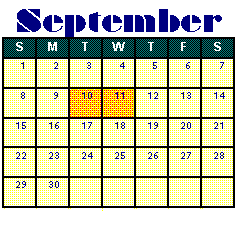 | |
- Tuesday, September 10, 1996
- Administrative Rules Review Committee
10:00 a.m., Room 22
- Wednesday, September 11, 1996
- Administrative Rules Review Committee
9:00 a.m., Room 22
|
Co-chairperson: Senator Berl E. Priebe
Co-chairperson: Representative Janet Metcalf
- Location: Committee Room 22, State House, Des Moines
- Date & Time: Tuesday, August 13, 1996, 10:00 a.m., Wednesday, August 14, 1996, 9:00 a.m.
- Tentative Agenda: Agenda (as Published in the Administrative Bulletin)
- Contact Person: Joe Royce, Legal Counsel, Administrative Rules
- FURTHER INFORMATION| CHARGE | MEMBERS | STAFF | HEARINGS |
Co-chairperson: Senator Berl E. Priebe
Co-chairperson: Representative Janet Metcalf
- Location: Committee Room 22, State House, Des Moines
- Date & Time: Tuesday, September 10, 1996, 10:00 a.m., Wednesday, September 11, 1996, 9:00 a.m.
- Tentative Agenda: Agenda (as Published in the Administrative Bulletin)
- Contact Person: Joe Royce, Legal Counsel, Administrative Rules
- FURTHER INFORMATION| CHARGE | MEMBERS | STAFF | HEARINGS |
July 2, 1996
- Background.
- Senate File 13 as enacted by the 1996 General Assembly directed that a Prospective Minor Parents Program Advisory Committee be created to carry out duties prescribed in the Act including the development and distribution of a video to be viewed by prospective minor parents, receiving of public input relative to the program, and ongoing evaluation of the program.
- Administrators and Officers.
- The Iowa Department of Public Health (IDPH) provides administrative support to the Committee and Director Christopher Atchison acts as secretary to the Committee. Following introduction of the members, opening comments, and review and adoption of bylaws, the members elected the honorable Judge Cameron Arnold as chairperson of the Committee and Ms. Mary Hill as vice chairperson of the Committee.
- Committee Business.
- Staff reviewed the materials provided, provided an overview of the legislative history of Senate File 13, and provided an overview of the responsibilities of the Committee.
- Video Vendors.
- Mr. Wendol Jarvis, Manager, Iowa Film Office, Iowa Department of Economic Development, provided information regarding contracting with a vendor for production and distribution of a video.
- Viewing of Video.
- The Committee viewed and discussed the video developed for the Attorney General's Child Support Recovery Initiative.
- Next Meeting.
- The Committee scheduled the next meeting through use of the ICN, on Tuesday, July 16 (a summary of that meeting appears in this calendar).
- LSB Monitor: Patty Funaro
July 3, 1996
- Alternate Energy.
- The Iowa Utilities Board met to consider several dockets relating to alternate energy issues. Midwest Wind Developers requested the Board to compel IES Utilities and Midwest Power (now, MidAmerican) to enter into contracts for the purchase of wind-generated electricity. Chapter 476 requires Iowa's investor-owned electric utilities to enter into long-term contracts to purchase the utilities' share of 105 megawatts of alternate energy at a rate of approximately 6.02 cents/kwh.
The Board made several decisions which will be set forth in a written order issued by the Board:
- IES and MidAmerican are required to enter into contracts for the purchase of alternate energy. The 6.02 cents/kwh rate as determined by rule by the Board will remain the rate for purchase. Available capacity will be determined on an average capacity basis and the contracts should include a performance requirement. The Board discussed requiring that contracts be entered into by a specific date, such as six months from the date of the written order.
- An out-of-state investor-owned utility can invest in an alternate energy production (AEP) facility. The Board reasoned that chapter 476 prohibits an investor-owned utility from being both an operator and an investor and that this out-of-state utility does not operate within the state and therefore does not violate Iowa law. A portion of an AEP project may be located outside of a contracting utility's service territory, but the utility cannot be compelled to accept power from outside the utility's service territory, although the utility may choose to do so.
- Windustries, a petitioner in this case, shall not be permitted to move ahead of other utilities in the queue system that the utilities have established. This system creates an order in which contracts will be entered into with AEP facilities based upon their placement on the list.
- Many of the points deliberated by the Board relate to the contract between the parties and the terms of that contract. The Board decided that land to be used by the AEP facility does not have to be under contract with the facility before the initial contracts between the facility and the utilities are entered into; that the parties shall determine an annual production limit through their contract negotiations; the initial contract should include a detailed milestone, for instance, a completion date of 10 years for all capacity to be acceptable; a working fund exhibit could be included in a later contract; and assignment provisions should not be limited. Regulatory or market-out clauses will not be approved as a provision of the contracts. These clauses would allow for changes or nullification of the terms of the contract if the regulatory climate changed.
- The Board made several decisions relating to interconnections between the utility and the AEP facility; interconnection studies do not need to be finalized before the contract is entered into; the AEP facility should be responsible for payment of system upgrades required by the AEP's interconnection onto the utility's system; and that AEPs may build their own interconnection facilities or pay to have the investor-owned utilities expedite action and specifically, the AEP facility, Zond Wind, and MidAmerican should split the costs of testing Zond's new Z-40 wind turbine before interconnecting it to MidAmerican's system.
- Midwest Wind Developers should be required to pay wheeling charges to Corn Belt Power Cooperative in the event of reverse power flows. Wheeling charges are fees paid for the use of transmission lines.
July 9-10, 1996
- Background.
- In February 1995, the Iowa Utilities Board initiated a notice of inquiry, Docket No. NOI-95-1, into emerging competition in the electric utility industry. As part of this inquiry, the Board formed the Electric Competition Advisory Group to evaluate issues associated with the emergence of competition in the electric utility industry. The advisory group includes representatives of utilities and Iowa businesses, as well as environmental and customer interests.
- Electric Utility Competition.
- On July 9, 1996, the Board staff held a tutorial session relating to electric utility regulation and changes that are occurring at the federal level. The session included presentation of information on the basics of the electric utility industry structure, rate of return regulation, determining prices using cost of service principles, retail competition and restructuring, competitive actions at the Federal Energy Regulatory Commission (FERC), a review of actions taken by other Midwestern states, in particular Wisconsin, Illinois, and Michigan, and a discussion of congressional activity relating to competition.
- Discussion of Proposals.
- On July 10, 1996, the Advisory Group met to discuss responses to the Iowa Utilities Board discussion paper entitled "Regulatory and Restructuring Options in the Electric Utility Industry". The following articles were submitted and discussed by various members of the group:
- Renewable Portfolio Standards, submitted by Windustries.
- Running of the Rails -- Safety Issues in a Deregulated Market, submitted by the International Brotherhood of Electrical Workers (IBEW).
- Public Interest Blueprint for Electricity Restructuring, submitted by a coalition of groups, including the Sustainable Energy for Economic Development Coalition (SEED).
- Competitive Franchise Legislation, submitted by the Iowa Association of Municipal Utilities.
- Monopoly and Antitrust Policies in Network-Based Markets such as Electricity, submitted by the Union of Concerned Scientists.
June 7, July 12 and 17, 1996
- Background.
- 1996 Iowa Acts, Senate File 2245, required the Iowa Public Employees' Retirement System (IPERS) to conduct several studies concerning the system and to report to the General Assembly's Public Retirement Systems Committee by September 1997. In addition, 1996 Iowa Acts, Senate File 2470, authorized IPERS to use a total of $85,000 from the Iowa Public Employees' Retirement Fund to conduct these studies.
- Special Studies Committee - Composition.
- The Special Studies Committee was formed by IPERS for the purpose of assisting IPERS in completing the required studies. The Committee, under the direction of the Chief Benefits Officer of IPERS, includes IPERS staff and representatives from various constituent groups interested in IPERS, such as AFSCME, Iowa State Education Association, Sheriffs' Association, Association of Counties, IPERS Improvement Association, Iowa League of Cities, School Administrators of Iowa, Retired School Personnel Association, and Association of Community Colleges.
- Conduct of Studies - Consultants.
- The Committee made the following recommendations concerning the use of consultants in assisting IPERS and the Committee in conducting the studies required:
- Retain Buck Consultants to assist IPERS in evaluating the utility of adding a supplemental plan to IPERS benefits. Buck would assist the Committee in attempting to define an ideal core plan of benefits for IPERS members and in identifying those vehicles for a supplemental plan deemed most feasible for IPERS members.
- Retain Buck Consultants to examine the issue of providing expanded disability benefits under IPERS and to make recommendations concerning the nature of the benefits provided and who, if anyone, should be provided coverage.
- Retain a consultant following a request for proposals to study the issue of converting IPERS to a defined contribution model, or a hybrid plan thereof, which would consist of elements of a defined contribution and defined benefit plan. The Committee agreed that the consultant should review the experience of any statewide public retirement systems in which such a conversion has been proposed or implemented and to consider various options for a partial or full conversion to a defined contribution model.
- Given financial constraints, the Committee agreed that IPERS would conduct, in conjunction with the guidance of the Committee, the necessary data gathering and surveying of other statewide public retirement systems concerning the issue of which occupations should be included as a protection occupation under IPERS.
- Core Benefits Plan.
- The Committee tentatively agreed that the following additional components to the benefits provided under IPERS should be considered in developing a core benefits plan for IPERS:
- More adequate benefits for designated beneficiaries of members who die prior to initiating retirement.
- Increased flexibility to a member who terminates public employment several years before retirement in regards to the accumulated value of that member's pension.
- An ad hoc cost-of-living adjustment program for members who retire after July 1, 1990. (SF 2245 provided for an adjustment for members who retired prior to this date.)
- An adjustable minimum benefits floor for low-earning members with minimum years of service who retire after July 1, 1990.
- No specific cap on years of service credit but with some overall percentage cap on benefits.
- Disability benefits, pending the results of the study on this issue.
- Elements of a Supplemental Plan Under IPERS.
- The Committee discussed what should be considered in developing a supplemental plan. Although the Committee reached no consensus on this issue, the Committee discussed various funding mechanisms for a supplemental plan, whether inclusion in the supplemental plan should be voluntary or mandatory for IPERS members, and whether this plan could be used to help provide health insurance coverage for retired members.
- Next Meeting.
- The next meeting of the Special Studies Committee is tentatively scheduled for August 2, 1996.
July 9-10, 1996
- Department of Agriculture and Land Stewardship
- Pesticide registration fees. In response to a petition for rulemaking, the department proposed a new exemption from the $250 minimum fee. Under the proposal, an Iowa-manufactured, nonagricultural pesticide would be exempt from the minimum fee if sales of the product were limited to $10,000 annually.
- Discussion. Under this proposal some $6,200 would be lost to the pesticide fund. At a public hearing on this proposal, rival manufacturers opposed the change, arguing that it should be expanded to cover additional pesticides. Those additions could raise the impact to the fund up to $500,000. Because of the controversy generated by this proposal, the department has decided not to adopt the exemption.
It was noted that the statute specifically gives the department the authority to establish exemptions from the minimum fee. However, department representatives contended that decisions having such a significant fiscal impact on the fund should only be made by the General Assembly.
- Credit Union Division
- Low-income credit unions. Pursuant to Senate File 376 and federal regulations, the division proposes to authorize low-income credit unions to receive nonmember shares and deposits from any source. Generally, credit unions are restricted to members who share some commonly held interest. To qualify as a low-income credit union, 50 percent of the members must be low-income. A qualifying credit union under this regulation could have up to 20 percent of its deposits, or $1.5 million, from nonmembers.
- Discussion. This proposal drew comment from the Iowa Bankers Association, which was primarily concerned that there is no real assurance that the additional funds would in fact be used to benefit low-income members. Concern was also expressed that there is not an adequate mechanism to ensure that a low-income credit union would remain eligible on an ongoing basis. No action was taken, but additional review is expected when the rules are adopted in final form.
- Environmental Protection Commission
- Wastewater analysis certification. Initially appearing in April, this program requires that labs performing analyses on wastewater obtain a biennial permit from the division. The filing is more stringent than the current provisions in that laboratories will be visited and certified on a two-year basis. It was estimated that a large wastewater treatment plant doing a lot of analysis would have an increase of approximately 25 cents per person which would be $12,000 to $20,000. The Committee imposed a 70-day delay to more definitively measure the economic impact of this certification program.
- Economic Impact. A department study has now concluded that the certification process will have a biennial cost to 150 Iowa municipalities of some $49,000. Some 30 to 50 industrial and commercial labs will also be affected with cost estimates of $22,000 for industry and $60,000 for commercial labs. These fees will go to the division for the administration of the program. The "payback" for this program is increased accuracy in the analyses submitted to the division. The required analyses currently cost Iowa cities some $3,000,000. Between 10 percent and 15 percent of the samples are inaccurate. Division representatives noted these analyses are used to calculate the need for improved sewage facilities and inaccuracies may cause facilities to be overbuilt or underbuilt. Based on this information, the Committee took no further action on this program, allowing it to go into effect on July 24, 1996.
- Department of Human Services
- Increased Child Care Benefits -- Senate File 2442. Under a new "emergency" rulemaking process for the Department of Human Services, a rule cannot become effective until it has been reviewed by the Committee. Under this provision, with the Committee's acquiescence, the department emergency implements a provision increasing the availability of day care to low-income Iowans. Under the rule, persons with an income up to 110 percent of the poverty guidelines will be eligible for subsidized child care services. This increase not only benefits the department's clients, but it also helps child care facilities that have long complained of the low level of reimbursement. While that level remains unchanged by the rules, income-strapped facilities will benefit from an increase in enrollees.
- Child abuse investigations. The Committee reviewed a series of revisions to the procedures used in child abuse investigations in pilot project counties. The proposal clearly reiterates current policy that only significant cases of abuse will be placed on the registry. The definition of significant abuse is carefully detailed both in the statute and the existing rules. While the rules themselves appeared noncontroversial, Committee members did express concern over the 70,000 persons currently on the abuse registry, and questioned whether it would be possible to review those cases to determine whether the individual situations would now be considered significant abuse. Department representatives responded that it would be virtually impossible to review each case. The Committee has decided to pursue this issue further, with an additional meeting either in August or September. Discussion will center on the possibility of having an appeal process where persons currently on the registry could request a review of their situation.
- Department of Transportation
- Tourist-oriented directional signing and logo signing. The department proposes several changes in its regulation of advertising signs on state highways. These small blue signs display the advertiser's logo, or denote local attractions, and are the only forms of advertising allowed on Iowa's highways. These rules are controversial because they propose a 100 percent increase in the fees for these logo signs--an increase vigorously opposed by small businesses. The department contends that the fee is necessary because: 1) the fee has not changed in over a decade; 2) the program to control signing no longer receives any federal funds; and 3) the 100 percent increase is necessary for the program to be self-supporting.
- Committee Action. Committee members still expressed concern over such a dramatic increase in cost, noting that the small business must still absorb a doubling of the current cost. The Committee took no further action but additional review is anticipated when the rule is adopted in final form.
- LSB Staff: Kathie Bates, Administrative Code Office
- Contact Person: Joe Royce, Legal Counsel, Administrative Rules
July 10, 1996, First Meeting of the Fiscal Year
- New Members.
- Ms. Mary J. Montgomery and Mr. Mark J. Schouten were welcomed as new members to the Commission.
- Educational Uses.
- The Commission discussed the definition of "educational" versus "administrative" use of the Iowa Communications Network (ICN) by educational institutions, including the appropriate rate that should be charged and priority allocated to educational institutions which are conducting educationally related business, but which are not engaged specifically in providing instruction. The Commission discussed the use of the network by K-12 schools and the extent to which possible rate changes could chill the use of the system by school districts. The Commission appointed a committee to explore this issue.
- Administrative Rules.
- The Commission approved administrative rules relating to Commission organization procedures. The rules were drafted by the Attorney General's Office and are based on rules adopted by other state agencies.
- Private Colleges.
- The Commission considered reports regarding the certification of private colleges to access the ICN. It was reported that although the period for certification has elapsed, several private uncertified colleges have expressed a strong desire to connect to the network. The Commission approved requesting that the Executive Council approve their connection on an interim basis, and that the Commission request that the General Assembly enact legislation allowing the institutions to permanently connect to the network. The Commission also approved extending the period until July 1, 1999, for several certified institutions to connect to the network. The Commission is in the process of preparing bids to several certified institutions to place all institution data, voice, and video traffic on the network as provided by statute.
- Authorized Users.
- The Commission reviewed the establishment of a task force to consider authorized use and authorized users. The task force is to be chaired by Mr. David Roederer, and will include representatives from industry and the General Assembly.
- Internet Access.
- The Commission considered demonstrations by U.S. West and MCI for providing Internet access to authorized users accessing the network. The Commission decided to take no action regarding proposals submitted by the two companies. Several Commission members supported the concept of partnering with industry, but stated that the idea was not ripe for decision. The Commission appointed a committee to further consider the concept.
- Next Meeting.
- The next Commission meeting is scheduled to be held on September 10, 1996.
- LSB Monitor: Doug Adkisson
July 11, 1996
Highlights of the meeting are as follows:
- Statistics and Measurements.
- Mr. Eric Sage, Department of Human Services, and Ms. Ann Thompson, Coalition for Family and Children's Services, discussed the difficulty of obtaining relevant statistical information regarding the success of programs to reduce juvenile crime due to the many different opinions as to what constitutes a good measure of success. The task force discussed the information that is currently available from the State Court Administrator's Office and other sources and the need for a better statewide information source.
- Curfews.
- The task force discussed the issue of curfews and whether any of the members had experience with a curfew in their communities. Mr. Stephen Smith, Chief Juvenile Court Officer for the 1st Judicial District, discussed a proposal by the city of Waterloo and the task force discussed whether options existed which might address juvenile crime issues short of a curfew. The task force was also provided a handout containing an article by the federal Office of Juvenile Justice and Delinquency Prevention regarding curfews and the legal challenges which may arise when a curfew is adopted.
- Parental Responsibility.
- The task force discussed California Penal Code section 272, which holds parents criminally liable for the acts of their children by imposing a duty on parents to exercise reasonable care, supervision, and control of their children. A parent found to have violated this provision is convicted of a misdemeanor and is subject to a fine of up to $2,500, one year's imprisonment, or both. The task force discussed whether community-based programs which encourage parents to take an active role in dealing with the delinquent behavior of their children may be a more effective tool than a criminal statute in the manner of California's. It was the consensus of the task force that a criminal provision such as section 272 would be an effective attention getter for some parents.
- The Crime Vaccine.
- Mr. Jay Marcus, a Fairfield, Iowa, attorney and former candidate for Iowa Attorney General in 1994, discussed his new book, "The Crime Vaccine", and provided the task force with a handout. In his book, Mr. Marcus discusses the physiological characteristics common to criminals and how those characteristics may be altered in a positive way through improvements in diet and the use of transcendental meditation. Reducing the physiological imbalances common to criminals will act like a vaccine, reducing the incidence of criminal behavior.
- Next Meeting.
- The next meeting and agenda of the task force are to be announced.
- LSB monitor: Mike Kuehn
- Contact person: Marilyn Lantz, Director, Juvenile Law Division, Iowa Department of Justice
July 11, 1996
- Electronic Filing Update.
- An updated test version of the software that will allow political committees to file electronically their disclosure reports with ECDB was sent to approximately 40 committees during the first week of July.
- Legislative Update.
- The Board reviewed a summary of the legislative changes proposed by ECDB during the last legislative session, but which were not enacted. These issues and others were referred to the Policy Committee to determine the legislation that ECDB will propose for the next session.
- Board Policy Action.
- Among the issues to be reviewed by the Policy Committee are (1) the conditions for proper use of corporate facsimile machines to send documents to ECDB, including consideration of communities or areas where a facsimile machine other than a corporate-owned machine is not reasonably available, and (2) whether a candidate may ever personally assume a corporate debt. The Board also considered, among other agenda matters, a request for an advisory opinion regarding a candidate's use of vehicles and dwellings owned by the candidate's family farm corporation, and agreed with legal counsel's interpretation of the statute that such property may not be used by any candidate for office. The Board reviewed a recent advisory opinion issued by the Federal Election Commission (FEC) which disapproved as an improper corporate donation the granting of free computer online/internet access accounts, even when granted equally to all candidates. Finally, the Board adopted administrative rules clarifying the conditions under which minors and trusts may make contributions to political committees.
- Next Meeting.
- The next meeting of the Board is scheduled for August 8, 1996.
July 16, 1996
The Committee agenda included all of the following:
- Legal Issues.
- Mr. Grant Dugdale, Office of the Attorney General, was present to discuss questions relating to the production and distribution of the video.
- RFP Requirements.
- The members discussed producing the video so that it is closed captioned for the hearing-impaired and concluded that closed captioning is required under the wording of the statute. The members also discussed providing the video in languages other than English and agreed that costs of providing the video in other languages should be researched but that this would not be a primary focus of the production.
- RFP Timeline.
- Mr. Fries noted that a bidders conference for potential applicants for the RFP would be held on July 23, 1996. Mr. Fries also noted that the RFP notice would be published in the Iowa Administrative Bulletin on July 18, 1996, and that all RFP applications are required to be submitted no later than August 16, 1996.
- RFP Scoring.
- The members agreed that only voting members of the Committee would actually score the RFPs submitted, but that prior to the scoring, all members would meet to discuss the applications.
- Future Meetings.
- The Committee scheduled the next meeting for August 6, 1996, to be held at the Learning Resource Center in West Des Moines, Iowa. The agenda for the meeting will include a discussion of the philosophy and content of the video.
The Committee also scheduled a meeting for September 6 and 7, 1996, to be held in West Des Moines. All of the members would review and discuss the applications, the voting members would make their decision, and the applicant selected would be notified on September 6, and the applicant selected would meet with the Committee on September 7, 1996.
- LSB Monitor: Patty Funaro
July 17, 1996
The Purple Ribbon Property Tax Reform Committee, established and staffed by the Iowa League of Cities, conducted its second meeting on Wednesday, July 17, 1996, at the Starlite Best Western in Ankeny, Iowa.
- ISU Presentation.
- Mr. David Swenson, Research Associate, Department of Economics, Iowa State University, made a presentation relating to the patterns of change in the property tax base and fiscal capacity of local governments in Iowa. Mr. Swenson stated that the current statutory limits on property taxation are extremely restrictive to local governments. Mr. Swenson stated that the fiscal limitations placed on local government by the state have contributed to a climate of antagonism between the executive and legislative branches and local governments. This, combined with the failure of local governments and their representative entities to promote the value of local government goods and services to the taxpayers or to state government, creates cause for concern.
- Subcommittees.
- The remainder of the day was spent in breakout sessions of the Blue and Red subcommittees. The focus of the Red Subcommittee is to consider, in general, what property should be taxed and the basis upon which it should be taxed. Issues considered by the Red Subcommittee include classification of property, tax credits and exemptions, methods of valuation, equalization orders, and the valuation rollbacks. The focus of the Blue Subcommittee is to consider the services supported by property taxes, the property tax revenue structure, and the other sources of local government revenue. Issues for this subcommittee include tax levies and limits, tax increment financing and tax abatement, funding by debt, local option taxes, and user fees and charges.
- Next Meeting.
- The third, and final, meeting of the Purple Ribbon Property Tax Reform Committee is scheduled for Thursday, August 22, 1996.
- LSB Monitor: Susan Crowley (515) 281-3430
July 18, 1996
- University Operating Budget Testimony.
- The Iowa State Board of Regents accepted testimony from University of Iowa President Mary Sue Coleman, Iowa State University President Martin C. Jischke, and University of Northern Iowa Robert D. Koob relating to the proposed operating budgets of the three universities. President Jischke noted that faculty and Professional and Scientific
(P&S) employees of ISU will receive average salary increases of 2.9 percent for FY 1997, while President Coleman and President Koob reported that those employees of the U of I and UNI will receive average salary increases of 4 percent for FY 1997. Merit employees will receive the 2.5 percent increase under the union contract and a merit step if eligible at all three institutions. Unless the Legislature approves a supplemental appropriation of $1.7 million, the university presidents told the board, the faculty and P&S employees of ISU will
not be granted the average 4 percent increase in salaries, and undetermined reductions in other expenditure categories will have to be made at U of I and UNI to support the average 4 percent increase in salaries granted at U of I and UNI for FY 1997.
- Next Meetings.
- The next Iowa State Board of Regents meetings are scheduled to take place September 17-18, 1996, at the University of Iowa in Iowa City.
- Staff Contact: Louise Kuntzelman, Iowa State Board of Regents
- LSB Monitor: Kathy Hanlon
July 19, 1996
- Notification Form.
- The Committee discussed the form to be used in notifying an alleged father of the intent to establish paternity and support administratively. The Committee agreed that a short cover page should be developed and included with the notice materials. The department will develop the cover page for the Committee's review at the next meeting.
- Collection Rules.
- The Committee business included an explanation and discussion of the rules for determining the date of collections for the purpose of distribution of collections.
- Subcommittees.
- Introduction and membership of subcommittees of the Advisory Committee. The subcommittees include the guidelines/policy review, legislative/operations review, and public awareness. The guidelines/policy review subcommittee provided a progress report noting that the subcommittee has brainstormed regarding general topics for review.
- Next Meeting.
- The next meeting of the Child Support Advisory Committee will be held on September 20, 1996.
- LSB Monitor: Patty Funaro
- Congressional Action.
- Although bipartisan campaign finance reform bills are pending in both chambers, neither chamber is expected to pass any legislation on this subject prior to the fall elections.
The Senate bill (S.1219), sponsored by Senator John McCain of Arizona, essentially died on the Senate floor in June when senators voted 54-46 to close debate, which prevented the measure from advancing. The legislation would have set voluntary limits on Senate campaign expenditures in return for benefits such as free and discounted broadcast time and reduced postage rates, eliminated political action committees, required disclosure relating to soft money contributions, and required 60 percent of campaign contributions to come from a candidate's home state. The Senate Majority Leader, Trent Lott, has indicated that he will not bring up the matter again during this session.
The House originally scheduled consideration of campaign finance reform during a week of debate on a "reform" package which included a number of topics, but has postponed the matter several times. Debate on the campaign finance issue occurred on July 25, 1996, but the bill did not pass the House. The House bill (H.R. 3820) would have lowered the amount of money a political action committee could donate in federal elections, prohibited bundling of donations by political action committees, raised the amount an individual could donate to a federal candidate, required the majority of donations to be made by residents of the candidate's district, and placed certain restrictions on soft money contributions.
- U.S. Supreme Court Decision: Colorado Republican Federal Campaign Committee v. Federal Election Commission. (Decided June 26, 1996.)
- The Federal Election Commission (FEC) had charged that the federal campaign committee of the Colorado Republican Party (CRP) had violated the federal statutes limiting party expenditures on behalf of a candidate, when it purchased radio advertisements attacking the likely Democratic candidate for the U.S. Senate, although it had already assigned its entire spending allotment for the general election to the National Republican Senatorial Committee. In a 7-2 decision (comprised of four separate opinions), the Supreme Court held that such an application of the party expenditure provisions violated the First Amendment of the U.S. Constitution.
The main opinion classified CRP's purchase of the radio ads as an "independent" expenditure, rather than as an expenditure coordinated with the party's candidate (i.e., a contribution), because the party staff alone made the decision to purchase the ads, and the party had not yet chosen its candidate at the time of the advertisements. Under the analysis set forth in Buckley v. Valeo, 424 U.S. 1 (1976), expenditures and contributions are treated differently under the First Amendment. While contributions to campaigns may be limited in order to prevent the possible exchange of a large contribution in exchange for a political favor, the government has no such interest in restricting money spent to advertise political views independently of a candidate's campaign. Consequently, the Court has previously held that independent expenditures cannot be limited by statute. The plurality saw no reason to deny political parties the right to make such independent expenditures, and specifically rejected the argument that any expenditure by a party on behalf of any of its candidates is a "coordinated" expenditure.
Four justices concurred in the judgment, though not in the reasoning. The two dissenting justices disagreed with the judgment because they believe the federal government has a valid interest in regulating campaign spending limits.
 Back to top of Interim Information
 Iowa General Assembly
 Search: 1995 Interim (76th General Assembly)
© 1996 Cornell College and
League of Women Voters of Iowa
Comments?
webmaster@legis.iowa.gov.
Last update: Fri Jul 26 17:01:04 CDT 1996
URL: /DOCS/GA/76GA/Interim/1996/calendar/960726.htm
sw